Automotive body structure 101
The automotive body structure is one of the most critical systems in a modern vehicle, serving as the central framework that unifies all other subsystems. It provides the foundation for accommodating the drivetrain, supporting the suspension, and protecting passengers and cargo. At the same time, it must meet a wide range of requirements: structural, functional, aesthetic, and economic.
A robust body structure is designed to withstand loads and incorporate controlled crush zones to enhance crashworthiness and occupant safety. Equally important, it must be lightweight to optimize fuel efficiency, energy management, and ride quality, while also being suitable for mass production at a competitive cost.
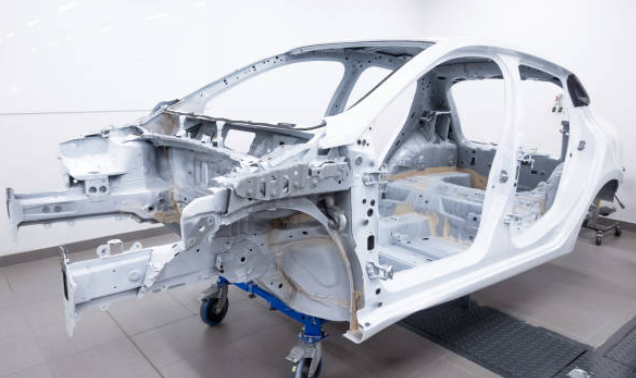
Beyond its structural role, the body defines a vehicle’s style and character, which often becomes the first point of design development and a decisive factor in consumer appeal. Typically, passenger vehicle bodies are assembled from numerous stamped sheet metal components, each selected for specific geometry, material type, and grade to balance performance, safety, and cost. Over time, various design approaches have emerged, each offering unique advantages and trade-offs in pursuit of stronger, safer, and more efficient vehicles.
What is the purpose of an automotive body structure?
The automotive body structure provides many functions. However, the primary function of a car’s body is to minimize the consequences of automobile accidents. It does this by enhancing passive safety, while also contributing to the overall design appeal and ride comfort of the vehicle. The outcomes of accidents and the survival of passengers hinge on the level of human exposure and the spatial requirements necessary for passenger survival. When more robust car body components come into contact with a solid barrier during an impact, the degree of human exposure relies on the crumple zone capacity to absorb kinetic energy. This entails the use of carefully designed structural elements made of steel, aluminum, plastic, or composites.
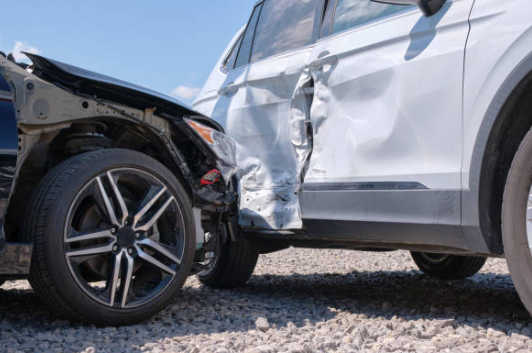
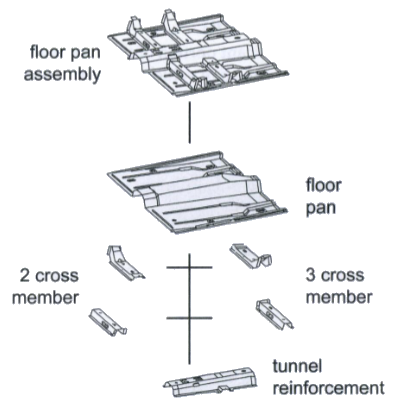
The automotive body structure is key in ensuring a vehicle meets its crashworthiness standard and thus can be sold. Depending on the type of crash, large parts of the frame could act as structural load paths to help keep the occupants inside the vehicle the same. For example, the B pillar and cross members on the floor pan assembly help keep redirect loads away from the occupant in the event of a side impact crash.
What material is the automotive body structure made of?
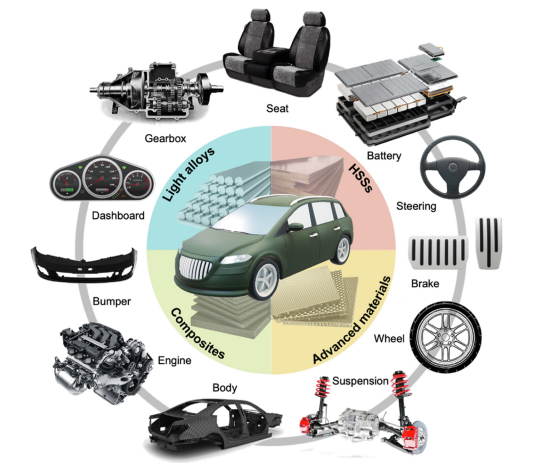
Current vehicles are crafted from an extensive array of advanced materials, including:
- Aluminum
- High-strength steel
- Ultra-high-strength steel
- Boron
- Magnesium
- Carbon fiber
- Plastic.
Raw materials cost about 47% of the cost of a vehicle. Steel, iron, plastic, aluminum, and glass account for 65% of the materials used in vehicles, while other materials make up the remaining 27%.
What is the automotive body structure of a car?
In the automotive industry, the automotive body structure (car body) is also known as the body-in-white (BIW). There are 3 main types of vehicle architecture in the automotive industry: a body-on-frame/ ladder frame construction, a space frame, and a unibody type design. Of these 3, unibody construction is the most common for the vast majority of passenger cars and crossover SUVs. Body-on-frame designs are usually only used for full-size trucks and SUVs.
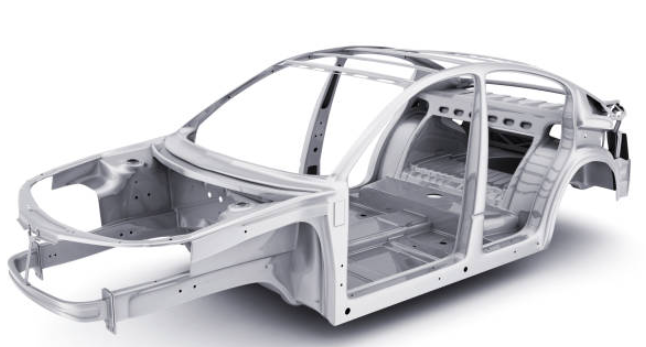
The vast majority of vehicle bodies on the road today rely heavily on steel. Due to its high strength and low cost, it is still the primary material in the structure design. However, the grade of steel can vary drastically throughout the vehicle. For more information on the material used in auto bodies, see Common Types of Steels found in Automotive Structure Design.
Body Structure Design Requirements
The performance of an automobile body structure is governed by several key requirements: structural stiffness, durability, crashworthiness, and noise, vibration, and harshness (NVH). To meet these demands, the body structure can be grouped into three functional categories:
- Load bearing components with minimal deformation designed primarily to resist loads through stiffness.
- Energy absorbing components with significant deformation designed to manage crash energy and enhance safety.
- Close out and aesthetic panels designed to define the vehicle’s exterior styling. These panels are usually made from thin, highly formable metals that allow for complex shapes and smooth surfaces, emphasizing the aesthetic and aerodynamic qualities of the design.
Distinguishing between these three roles is essential, as each is governed by different design priorities and mechanical principles.
Stiffness
Stiffness refers to a structural member’s resistance to deformation under load, which depends on both the modulus of elasticity of the material and the geometry of the component, especially its moment of inertia. In automotive applications, stiffness is crucial for components that support chassis and suspension systems, as well as for reducing NVH levels.
At the vehicle level, the body must also achieve high static bending and torsional stiffness to properly accommodate road input loads and allow engineers to tune ride and handling performance. Because the elastic modulus of all steel grades is essentially constant, geometry becomes the primary design lever for stiffness. Substituting conventional steels with advanced high strength steels (AHSS) does not inherently increase stiffness, but the improved formability of AHSS enables more complex geometries. This allows for added stiffness while simultaneously enabling reductions in sheet thickness to decrease vehicle mass.
Strength
Strength dominated components are designed to withstand significant loads, often with controlled levels of deformation. Some elements must maintain structural integrity under high stresses, while others must absorb large amounts of energy with minimal deformation to protect occupants in a collision.
For these cases, the use of higher strength materials such as AHSS offers clear advantages. By combining geometric optimization with higher material strength, engineers can achieve robust load bearing capacity, enhanced crash performance, and mass reductions.
Automotive body structure: ladder frame design structure
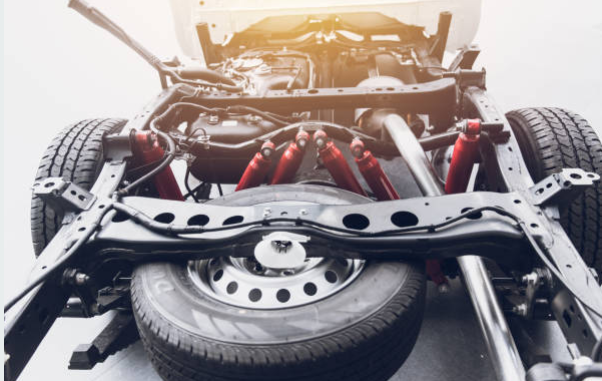
The traditional vehicle structural design, known as the body-on-frame construction, features a frame typically comprised of two parallel connected rails forming a “ladder frame” to which the suspension, wheel, and tires are attached. The remaining body or shell is positioned on top of this frame. Widely used until the early 1960s, this concept was employed by almost all cars globally. Initially constructed from wood, particularly ash, the frames transitioned to steel ladder frames in the 1930s. Currently, the frame design is primarily reserved for pickup trucks and full-size SUVs, resembling a ladder with two longitudinal rails linked by various lateral and cross braces.
The longitudinal members serve as the main stress-bearing components, managing both the weight and the vehicle dynamic forces resulting from acceleration and braking. Lateral and cross members provide resistance against lateral forces and enhance torsional rigidity. Ladder frames are favored in trucks due to their overall strength and weight-bearing capabilities. However, some drawbacks include their significant weight and the need for improvement in torsional body stiffness due to their two-dimensional structure. Furthermore, frames occupy valuable space and raise the center of gravity, compromising safety as the rigid rails do not deform upon impact, leading to a higher transfer of impact energy into the cabin and the other vehicle.
Automotive body structure: space frame structure
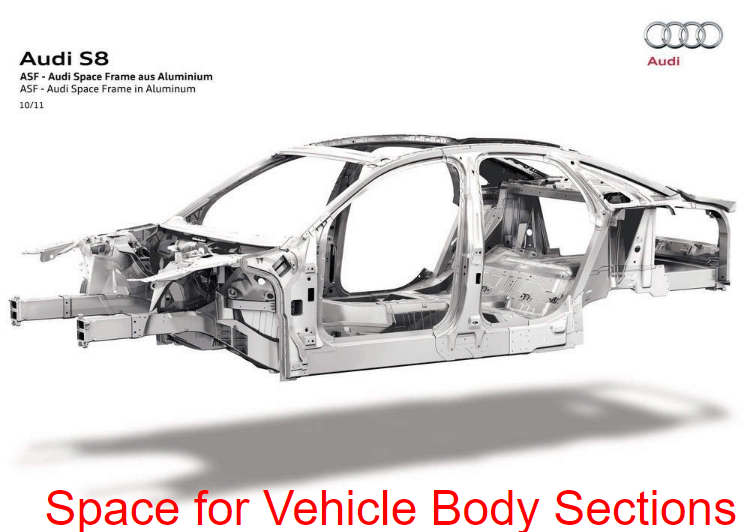
The structural design of the house frame body takes advantage of the opportunity for extensive half integration, aiming to reduce manufacturing and tooling expenses while enabling a weight reduction exceeding 40%. Although the assembly of top-notch structural pressure die castings and shaped, machined extruded sections incurs relatively high costs, significant overall cost savings are realized for small and medium production volumes when compared to purely sheet-based body design concepts. Nevertheless, the house frame construction incorporates a substantial proportion of formed sheet components. Particularly, the sheet elements positioned between the frame components play a crucial role in determining the structure’s rigidity.
Automotive body structure: unibody design structure
Most automobile bodies do not adhere strictly to the monocoque design; instead, current cars employ a unitary construction commonly known as the unibody design. This design incorporates a network of box sections, bulkheads, and extruded beams to generate the majority of the vehicle’s strength, with the stressed skin contributing comparatively little to the overall strength or stiffness. The unibody design facilitates a substantial reduction in the weight of the car body, enabling a more compact yet spacious vehicle configuration.
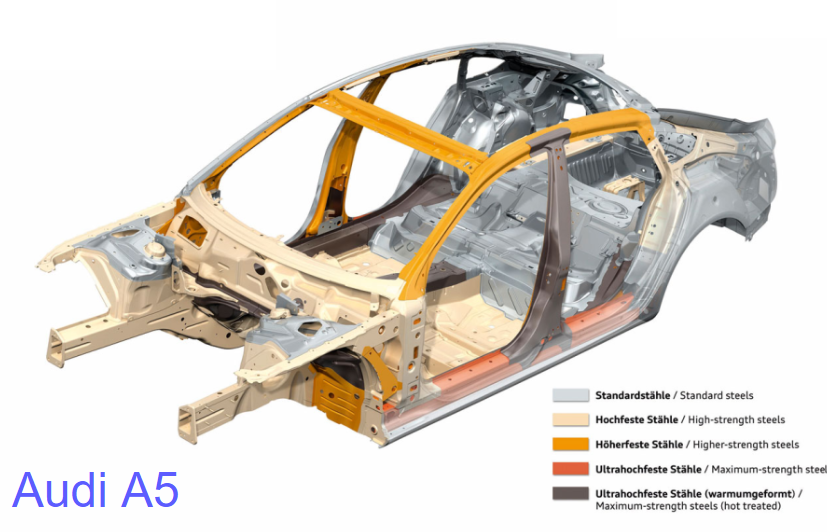
Furthermore, safety is improved by incorporating energy-absorbing deformation zones into the unibody structure. The rigidity of the automobile body may be somewhat compromised since the foundational monocoque assembly consists of sheet panels that are typically spot-welded, providing only localized connections, especially in the case of steel designs. However, it is feasible to enhance the stiffness of the unibody by employing continuous joints, such as adhesive bonding or laser welding, or by integrating beams, closed sections, or other stiffening elements. Conversely, in the event of a severe collision involving a vehicle with a unibody design, repairs may prove more challenging compared to a full-frame vehicle.
What is a body-in-white & define its parts?
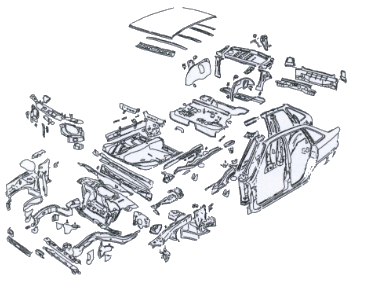
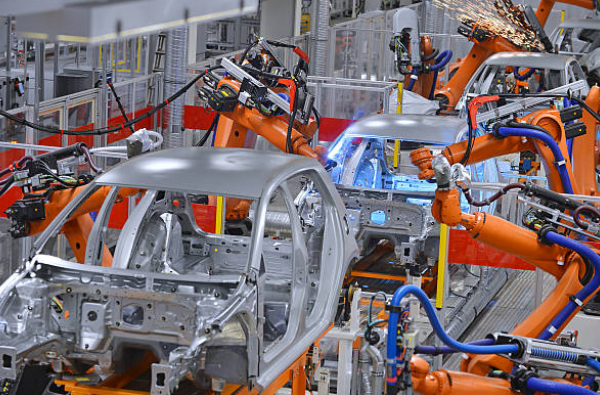
Automotive manufacturers such as General Motors, Ford, and Honda use the term BIW to refer to a fully assembled automotive body structure. This system of the vehicle is usually assembled in a body shop with resistance spot welding (RSW). RSW is commonly used in automotive manufacturing due to its low cost and high repeatability. The Automotive BIW is made up of several assemblies:
- Upper Structures (Roof/ A, B, C & D Pillars/ ext.)
- Lower Structures (Floor Pan/ Rear Compartment/ Rockers/ ext.)
- Closures (Hood/ Doors/ Lift Gate)

Fusion welding sheet metals is usually used to join vehicle BIW structures together. The only exceptions to parts that are not welded together are:
- moving parts: the doors, hoods, deck lids, fenders, windshield wipers
- trim glass, seats, upholstery, electronics,
- the chassis sub-assemblies and the powertrains
RSW is also not used on any exterior auto body panel due to the poor surface finish. Most vehicle closure parts, such as the doors, use hemming to join the door structure to the exterior door skin.
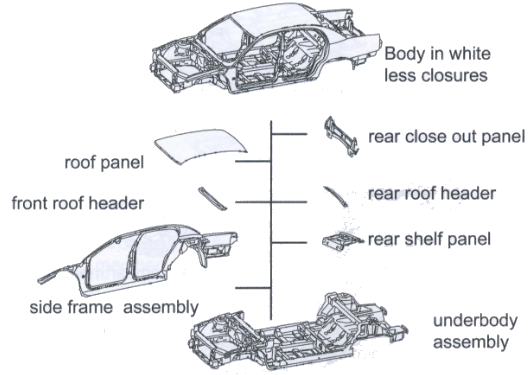
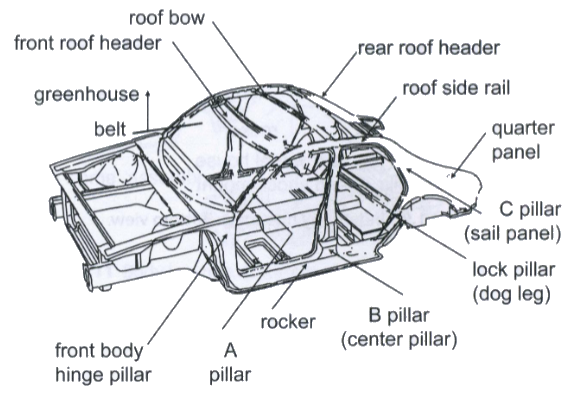
Side and greenhouse members/Upper Structure Assembly:
Upper structure assembly usually consists of the following sub-assemblies
- roof sub-assembly (roof panel/ front and rear roof header and roof bows)
- Rear end sub-assembly ( quarter panel inner/ rear end panel / D pillar inner/ext.)
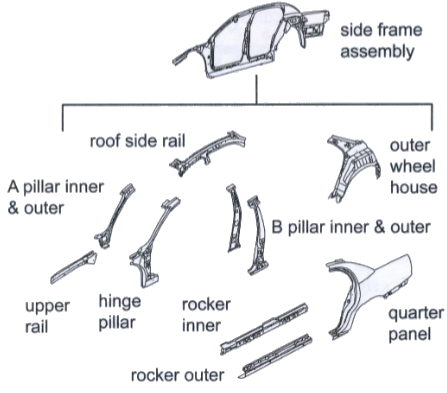
- body sides sub-assembly ( Body side outer/ B Pillar inner/ hinge pillar/ ext.)
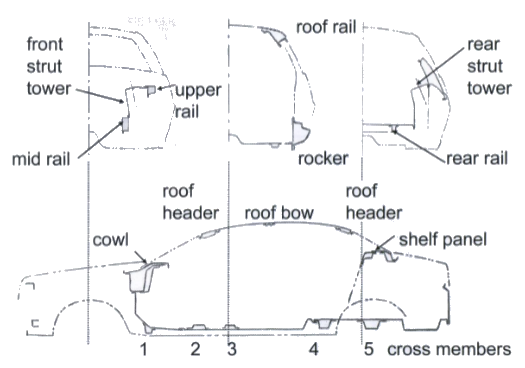
What is a master section in BIW?
A section is a 2D representation or slices through a vehicle. Packaging and BIW Engineers primarily use 2D sections during the initial part of the BIW development, when 3D CAD models are still too premature to evaluate a vehicle. They help engineers ensure they are providing adequate packaging space for all components that will occupy a specific area of a vehicle.
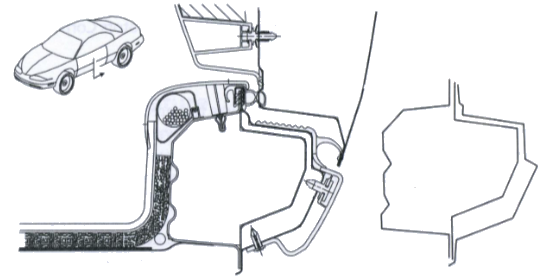
The typical section at the rocker:
What is the side of a car called?
Body sides can be broken down into two assemblies:
- Body Side Outer (BSO) – all the class A (customer-facing components). Most BSOs are stamped out of one giant die. Due to the complex geometry, the type of steel that this panel is made out of must have good ductility while proving good dent resistance, such as bake-hardening steel.
- Body Side Inner (BSI) – The load-bearing elements behind the class A surface
What is automotive platform sharing?
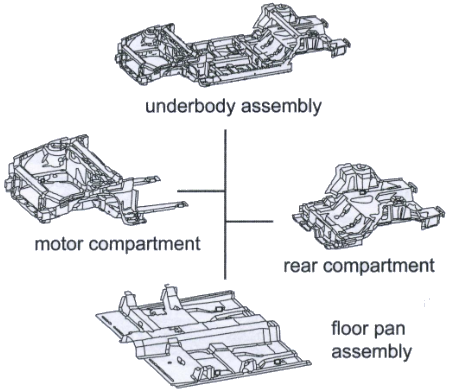
The underbody subassembly can also be referred to as the vehicle platform. An example is the Bronco Sport and the Ford Escape, which are on a shared platform, Ford’s C2 platform. The underbody interfaces with a vehicle’s suspension system, so by keeping the underbody similar, you can carry over many of the same components in the chassis and thus drive down the cost of the vehicle development.
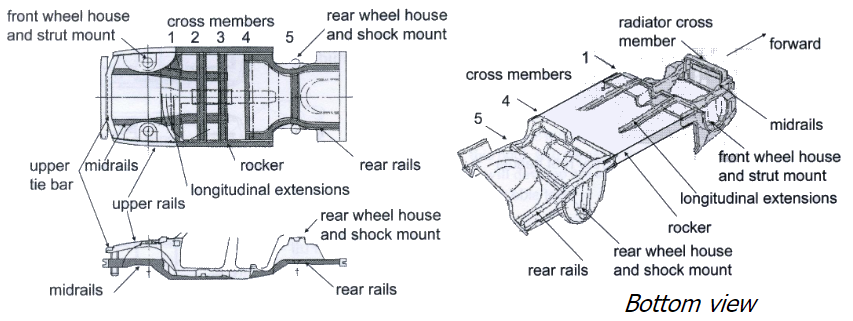
Underbody Members:
What are the front parts of a car called?
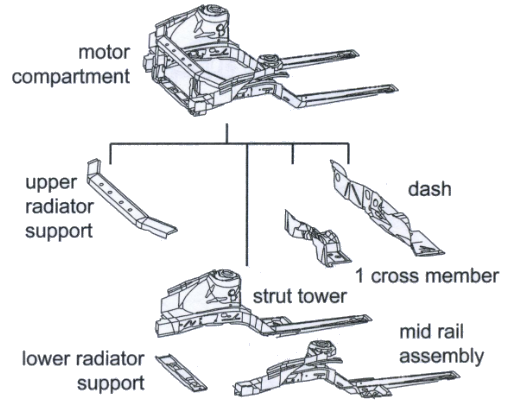
The front part of a car is commonly referred to as the front motor compartment. On a traditional gas or diesel-powered vehicle, this is where the internal combustion engine would be packaged. A breakdown of the front motor compartment can be seen below.
What is the bottom of the car called?
The bottom of a car is known as the floor pan assembly. However, the dirty side (facing the road) is commonly known as the undercarriage. Several automakers are currently experimenting with casting large parts of the floor pan and rear compartment out of one mold, thus reducing the number of parts and complexity of the underbody subassembly.
What is the rear panel of a car?
The rear compartment (rear of a car) is made up of the rear BIW structure, the rear bumper, and the quarter panel (part of the body side outer). The rear bumper on most vehicles is just a plastic part that mounts the rear-end panel of a BIW. The purpose of the rear bumper is just to act as a beauty cover and provide a location to mount the license plate.
The structural bumper is behind the plastic rear bumper. The quarter panel is a class A body panel, the rear of the rear doors. The breakdown of the parts of the rear compartment can be seen below:

Conclusion
The automotive body structure serves as far more than a simple frame to which subsystems are attached. It is a carefully engineered system that must satisfy a wide range of requirements, from structural stiffness and crashworthiness to durability, noise reduction, and styling. Each component of the body structure plays a distinct role, whether it is designed to resist loads, absorb energy, or provide the aesthetic form that defines the vehicle’s character.
Advances in materials, particularly the use of advanced high-strength steels, have enabled engineers to optimize both stiffness and strength while simultaneously reducing mass. At the same time, design practices continue to evolve to balance cost, performance, and manufacturability with the growing demands for safety, efficiency, and consumer appeal.
Ultimately, the body structure remains at the core of automotive design. It not only unifies all other vehicle systems but also provides the foundation for safety, performance, and style. Understanding its functions and design requirements is essential for appreciating how modern vehicles achieve the delicate balance between engineering excellence and market expectations.