
Car Roof Parts and Types: Names, Diagram, and Sunroof vs. Moonroof
A car roof is the structure above the passenger compartment. It is made up of an outer panel supported by front and rear headers, side roof rails, and transverse roof bows. Most vehicles have a fixed metal hardtop; other types include sunroofs, moonroofs, panoramic glass roofs, convertibles, T-tops, and targa tops. This guide starts with the part names and roof types, then explains how engineers design a roof for strength, styling, and aerodynamics.
Parts of a Car Roof

The roof panel assembly is made up of different components depending on what variation of roof you may be dealing with, but the most common components are front and rear headers, roof bows, roof ditch/roof rails (roof ditch modeling execution), sunroof module, sunroof ring (only applicable to sunroof vehicles), and the roof outer panel /glass roof.

Types of Car Roofs
There are several distinct types of automobile roofs, each with its own construction and trade-offs between weight, cost, and open-air feel:
- Hardtop – a fixed, solid roof made of steel, aluminum, or composite panels with no folding or retracting parts; the standard configuration on most passenger vehicles.
- Convertible – a roof that folds or retracts to open the cabin, in three common forms: a soft-top (fabric, lightweight and quick to operate), a retractable hardtop (rigid folding panels that stow in the trunk), and a targa top (a removable center panel paired with a fixed rear roll bar).
- Sunroof – a smaller glass or metal panel built into a hardtop that tilts or slides open for ventilation, with an electrically adjustable sunshade underneath.
- Moonroof – functionally similar to a sunroof, but larger and typically made of tinted glass with power controls.
- T-top – two removable panels positioned above the driver and front passenger, separated by a fixed structural bar down the center of the roof.
- Panoramic roof – an extended glass roof that stretches from the front seats to the rear seats, giving an open-sky view without any panel retracting.
Currently, the hot new thing that automakers have started to experiment with is integrating large glass panels on all-glass roofs.

Sunroof vs. Moonroof vs. Panoramic Roof
The short version: a sunroof traditionally is an opening panel, a moonroof is a tinted glass version of that panel, and a panoramic roof is a much larger glass area that extends over the rear seats. In practice, automakers often use “sunroof” and “moonroof” interchangeably, so check how the panel actually works on the specific vehicle.
| Roof type | Typical construction | Does it open? | Main trade-off |
|---|---|---|---|
| Sunroof | Small metal or glass panel set into a hardtop | Usually tilts or slides | Lowers headroom slightly and adds parts that must seal against water |
| Moonroof | Tinted glass panel, usually power operated | Usually tilts or slides | Adds mass high on the vehicle and needs a sliding mechanism and drains |
| Panoramic roof | Large glass area spanning front and rear seats | Varies: some are fixed, some have a sliding front panel | Most glass area and mass, with more solar heat to manage |
| Fixed metal roof | Stamped steel or aluminum outer panel | No | No view of the sky, but the simplest and usually lightest option |
From a structural standpoint, any opening means cutting into the roof panel, which is why sunroof-equipped vehicles add a reinforcing ring and a module to house the mechanism. Bonded glass also has to stay bonded for the life of the vehicle: in 2026, Subaru recalled 69,663 2026 Forester and Forester Hybrid vehicles because the sliding glass panel of the power moonroof may have been improperly bonded to its frame and could detach (NHTSA recall 26V346).
Automotive roof design overview
The roof is not a singular component on a vehicle; rather, it comprises the Front Roof Rail (front header), Rear Roof Rail (rear header), Bow Roof Rail, and Center Roof Rail. These Bow Roofs are positioned in the flattest section of the panel. The Rear Roof Rail connects with the Back door and Body side outer, while the Front Roof Rail interfaces with the Windshield glass and body side outer.
What is automobile roof design?
When designing an automobile roof, automotive engineers must balance engineering and artistic design requirements while adhering to the federal safety standard requirements, roof crush (FMVSS 216a). Even though the body structure of a vehicle is composed of many parts, not all of them carry equal loads. The class A roof outer panel is made from thin, lower-strength material, which is more ductile and better at forming shapes to help enable the vehicle styling theme.
Underneath the roof outer panel of the vehicle are all the main load-carrying members, which are made from varying grades of high-strength steel. As federal requirements become more stringent and demand automakers to fabricate more fuel-efficient vehicles, automakers are becoming more creative in ways to cut mass while still meeting all vehicle requirements.
What is the use of a car roof?
An automobile roof or roof panel is part of the body structure and body-in-white upper structure subsystem. The body structure is made up of 31 parts, which can be divided into six core groups: A-Pillars, B-Pillars, C-Pillars, roof rails/roof ditch, roof panel assembly, and side panels (front, side, and rear closures) [8]. The roof panel assembly works with the rest of the BIW structure to protect the occupants in case of an impact by directing the load and forces away from the occupants.
What is a greenhouse in a car?
The roof system and glass windows (windshield, rear/side windows) are part of the greenhouse. The purpose of the greenhouse is to act as a barrier for the occupants from inclement weather. In sunlight these components warm up your car similar to a greenhouse; thus, that is how this area of a car got its name.

Why are most automobile roofs curved?
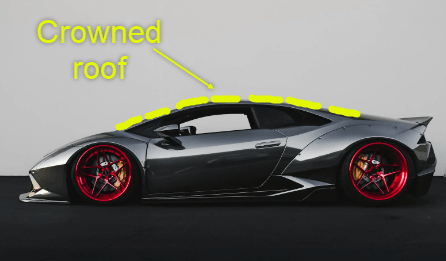
Automotive roofs are designed to have a slight crown, with a peak around the B-pillar. In addition to improving aerodynamic performance (fuel economy/range), the reason behind this is that the roof is designed to act as a water management system for the vehicle. During a storm, the water is redirected in the roof ditch to the front and back of the vehicle and away from the door openings.
The BIW system of a vehicle is like the foundation and frame of a house. All other components mount to the body-in-white, and the roof is no exception. The roof is the mounting surface for many parts, such as the headliner and substrate, electrical harnesses, airbags, grab handles, sunshade, sun visors, an overhead console, and radio antenna. Each of those components has specific packaging requirements that the roof must enable. Accessories such as roof racks also attach to the roof.
How does the automobile roof affect the aerodynamics of a car?
The roof is also an important player in achieving the desired aerodynamic performance. For optimal aerodynamic performance, the air should stay attached as it goes over the roof. Premature separation would cause extra turbulence, which would increase the overall vehicle drag and reduce fuel economy or range. Roof-mounted accessories such as roof racks also increase drag by increasing the frontal area of a car and increasing the drag coefficient, thus reducing a car’s aerodynamic performance. See our guide to automotive aerodynamics for how engineers measure and reduce drag.
Why do SUVs have ridges on the roof?
Since the roof panel is also part of the vehicle’s class A surface, in addition to all the engineering, performance, and integration requirements, the roof is also expected to be aesthetically pleasing. The artistic staff works hand in hand with engineers to make sure the design of the roof meets all best practices and manufacturing requirements, but also matches the rest of the vehicle’s theme.

The grooves or ridges sometimes seen on the roof of SUVs are artistically styled stiffening beads. These stiffening beads are added to strengthen the roof panel to prevent oil canning. These stiffening beads run fore-aft (front to back) and are usually spaced 250mm – 300mm (9in -12in) apart to reduce/eliminate any aesthetic defects in the panel, such as rippling, waviness, or buckling, which can be noticed in large flat cold-rolled sheet metal parts.
What is oil canning in automotive panels?
Sometimes, when you press down on a hood or roof panel of a car, you will hear a pop, bang, or clunking noise. This noise is due to the load on a large panel exceeding the critical buckling load Pcr, and as a result, reversing the curvature of the panel. Automotive panels are generally doubly curved. The curvature on these automotive panels is not the same in the orthogonal direction. The greater the stiffness of the panel, the greater the oil-canning resistance. The way to increase the Pcr for a roof panel is by improving the panel geometry/curvature, support conditions, and adding roof bows.

How do you measure an automobile’s roof strength?
According to the Federal Motor Vehicle Safety Standard (FMVSS), rollover crashes are some of the most dangerous automobile accidents. About 35% of occupants involved in rollover crashes die, which is more than 7500 people a year. This is because seatbelts on passenger seats are not effective at protecting occupants during a rollover because of their geometry. [8]

As a result, the FMVSS has developed a standardized test to check vehicle roof structure performance. The latest standard, FMVSS 216a, requires vehicles with a gross vehicle weight rating (GVWR) of 6,000 pounds or less to withstand a force equal to 3 times the unloaded vehicle weight (UVW). Vehicles above 6,000 pounds GVWR must withstand 1.5 times UVW. In both cases, the test device can move no more than 127 mm (5 inches), and no more than 222 N (50 lb) can reach a head form representing an average adult male. The test is conducted on both the driver and passenger sides. [8] Since the loading platen is placed forward of the C pillar, the main load-bearing structures during a roof crush test are the A-pillars, B-pillars, front header, and roof rails [7]. For the wider picture, see our guide to vehicle crashworthiness.
How strong is a car roof?
When you talk about an automotive roof, most people associate it with the exterior skin; however, even though the roof panel might be the largest component in the roof system, it does not carry or absorb major loads. The exterior skin of the roof only absorbs 12% of the loads during the event of a side impact crash, making it one of the weakest structural members [8].

High-strength steel (HSS) has gained rising popularity in the modern automobile industry for manufacturing structural members because of its outstanding performance and mature manufacturing technology. The main structural members of the roof are the headers and roof ditch/roof rails. Since these are main load-bearing structural components, they are commonly made from HSS, such as press-hardened steel, to limit roof crush in the event of a rollover or side impact [1][2].
How much force can a car roof withstand?
During an accident, the forces from the impact are transferred from the B-pillar to the rocker and the roof side rails. If the roof rails are not made from a strong enough material, significant intrusion into the upper structures would compromise headspace and lead to serious occupant injury. This space is so crucial that all major automotive companies have incorporated side curtain airbags to help protect the passenger [1][5].
In the event of a side impact accident, the front and rear headers also act as the primary load paths between both the BSO of the vehicle, redirecting loads to the other side of the vehicle and away from the occupants. In the event of a rollover, the headers also provide additional rigidity to the roof to prevent the collapse of the roof. By keeping the roof-to-windshield interface intact, the front header also plays an important role in reducing the likelihood of occupant ejection during an accident. [3]
Even though the primary purpose of the roof bow is to stiffen up the roof and prevent any fluttering during high vehicle speeds, if loads are high enough, the roof bow can come under load. In this circumstance, the roof bow would support the front and rear headers in order to provide additional reinforcement to the roof side rails and transfer the load to the other side of the vehicle and away from the primary load path. [1]
How thick is the metal on an automobile roof?
Most of the roof panels are made from thin, lower-carbon and bake-hardened steel panels, which traditionally have been less than 1.5mm thick. However, to reduce weight and to help enable class-A styling, the vast majority of roofs on new cars are only 0.65- 0.75mm thick. [1]. Every kilogram at roof height counts because it adds to vehicle mass and raises the center of gravity; see why modern cars keep getting heavier and our guide to lightweight automotive materials.
The manufacturing process of automobile roofs:
The exterior automobile roof panel is made of one large sheet of metal known as a blank, which is stamped in a press. If the vehicle has a sunroof, then the sunroof opening is cut out in the midst of the stamping operation. The formed roof is then sent to the body shop, where all the parts of the body structures will come together. During the initial assembly process, the BIW is held together with small toy tabs placed throughout the structure.

These toy tabs act as mechanical fasteners that hold the vehicle together while a robot starts to weld the load-bearing structural members together. The front and rear headers play a crucial part in holding the left and right body side outers (BSO) of the vehicle together during this initial assembly process. The roof panel is commonly one of the last parts of the BIW, which is welded onto the vehicle. To reduce complexity in the assembly process, the roof is top-loaded onto the BIW. Once placed on the top of the roof ditch, the roof panel is laser brazed on.
Laser brazing the roof panel on the car:
In recent years, laser brazing the roof panel onto the vehicle body has become increasingly popular since using this manufacturing technique provides a cleaner look by eliminating the need for roof ditch molding. During laser brazing, nonferrous metals such as bronze alloy are used as filler material. Usually, brazing uses lower temperatures than other welding techniques, which reduces the heat-affected zone and potential damage to the parts being welded. In laser brazing, only the filler material melts and joins the joining material. [6] When using the proper technique, you can achieve the same tensile strength of MIG welding by using the laser brazing process, and it is less harmful to the parts and easier to control. [6]

What is the outside body of a car called?
The “Class A body panels” or exterior closure panels of the vehicle provide little to no structural support. As a result, they are made from lower carbon steel, which is more ductile and can be stamped and formed in complex shapes to meet studio styling requirements. Some automakers will use high-strength bake-harden and dual-phase steels on these exterior closure parts, but this is only to improve dent resistance. [1]

An example of the A surface exterior closure body structure parts would be the quarter panels, fenders, exterior door panel, and exterior roof panel.[1] These lower-strength panels are then reinforced with high-grade steel brackets, reinforcements, and cross members, which give the body structure its strength and rigidity. Unlike the class A surfaces, these reinforcements and cross members are made from thicker sheet metal.
Frequently Asked Questions
What is the top of a car called?
The top of a car is called the roof. Its visible skin is the roof outer panel, and the structure underneath includes the front and rear headers, roof rails, and roof bows.
What is the difference between a sunroof and a moonroof?
A sunroof is traditionally an opening panel that may be metal or glass, while a moonroof is a tinted glass panel that usually tilts or slides. Many automakers now use the two terms interchangeably.
What is a roof bow on a car?
A roof bow is a transverse brace that spans the underside of the roof panel. It stiffens the panel, prevents fluttering at speed, and helps transfer load between the front and rear headers.
Are panoramic glass roofs as strong as metal roofs?
Vehicles with glass roofs must meet the same FMVSS 216a roof crush requirements as other vehicles. The main load paths are the pillars, roof rails, and headers rather than the outer panel, whether that panel is metal or glass.
When did cars start having roofs?
Initially, cars lacked roofs altogether. Subsequently, these early vehicles were influenced by the era of horse-drawn carriages. Early car roofs adopted similar materials and designs, incorporating folding canvas tops, some equipped with transparent side curtains. In 1905, Cadillac then marked a significant milestone by being the first manufacturer to introduce fully enclosed factory bodywork.

However, a demand for something intermediate arose, prompting a European response. By the 1920s, consumers could buy vehicles with roof openings covered in either canvas or metal, along with the patented Pytchley sunroof mechanism. In 1933, Hillman went a step further by presenting a sliding roof panel featuring glass windows on the Aero. In the present day, a variety of roof options, such as sunroofs, moonroofs, panoramic roofs, T-tops, or targa tops, are readily available on most new vehicles, each providing a middle ground between a fixed roof and a complete convertible.
What was the first hardtop convertible?
A convertible or cabriolet is a type of passenger car that can be operated with or without a roof. The techniques for retracting and storing the roof differ across different time periods and manufacturers.
The design of a convertible car enables an open-air driving experience, offering the flexibility to have a roof when needed. One potential drawback of convertibles is the diminished structural rigidity, which necessitates substantial engineering and modifications to compensate for the impact of removing the car’s roof. In 1935 Peugeot 402 Eclipse Decapotable is recognized as the first car featuring a folding hardtop roof.
What was the first car with a glass roof?
Sunroofs and moonroofs in automobiles have a lengthy history. The initial car equipped with a sunroof was produced in 1937, and the first moonroof was introduced in 1973, featured in the Lincoln Continental Mark IV of that model year. However, the first instance of a full panoramic roof was integrated into the 1953 Lincoln XL-500 concept car, showcasing a Plexiglas bubble canopy that extended the full length of the vehicle.

References
- C.D. Horvath, Chapter 2 – Advanced steels for lightweight automotive structures, Editor(s): P.K. Mallick,In Woodhead Publishing in Materials, Materials, Design and Manufacturing for Lightweight Vehicles (Second Edition), Woodhead Publishing, 2021, Pages 39-95, ISBN 9780128187128, https://doi.org/10.1016/B978-0-12-818712-8.00002-1 (http://www.sciencedirect.com/science/article/pii/B9780128187128000021)
- Cui, A., Xu, X., Sun, W., Yang, W., Huang, X., & Liu, T. (2020). Study on crashworthiness optimization of carbon-fiber sandwich panel structure with polypropylene foam core. [基于耐撞性的碳纤维/聚丙烯泡沫夹芯板结构优化研究] Qiche Gongcheng/Automotive Engineering, 42(6), 840-846. doi:10.19562/j.chinasae.qcgc.2020.06.020
- Konrad M. Dobbertin, et all, The relationship between vehicle roof crush and head, neck and spine injury in rollover crashes, Accident Analysis & Prevention, Volume 58, 2013, Pages 46-52, ISSN 0001-4575,
- https://doi.org/10.1016/j.aap.2013.04.020. Jeong-Min Lee, Byung-Min Kim, Dae-Cheol Ko, Development of vacuum-assisted prepreg compression molding for production of automotive roof panels, Composite Structures, Volume 213, 2019, Pages 144-152, ISSN 0263-8223, https://doi.org/10.1016/j.compstruct.2019.01.092. (http://www.sciencedirect.com/science/article/pii/S0263822318315009)
- Mahmood, H. F., & Baccouche, M. R. (1996). Design of automotive body structure for roof crush. American Society of Mechanical Engineers, Applied Mechanics Division, AMD, 218, 25-32. Retrieved from www.scopus.com
- Muthuraju, K., & Lakshmankumar, A. (2020). Experimental studies of different thick steel sheets and variable clearance in MIG brazing. Paper presented at the IOP Conference Series: Materials Science and Engineering, , 912(3) doi:10.1088/1757-899X/912/3/032078 Retrieved from www.scopus.com
- M.R. Bambach, Fibre composite strengthening of thin steel passenger vehicle roof structures, Thin-Walled Structures, Volume 74, 2014, Pages 1-11, ISSN 0263-8231, https://doi.org/10.1016/j.tws.2013.09.018. (http://www.sciencedirect.com/science/article/pii/S0263823113002401)
- Soroosh Borazjani, Giovanni Belingardi, Development of an innovative design of a composite-sandwich based vehicle roof structure, Composite Structures, Volume 168, 2017, Pages 522-534, ISSN 0263-8223, https://doi.org/10.1016/j.compstruct.2017.02.015. (http://www.sciencedirect.com/science/article/pii/S0263822317302052)
- UK project develops carbon/flax hybrid automotive roof, Reinforced Plastics, Volume 60, Issue 1, 2016, Page 6, ISSN 0034-3617, https://doi.org/10.1016/j.repl.2015.12.067. (http://www.sciencedirect.com/science/article/pii/S0034361715008796)
Definitions/Abbreviations
BIW Body-in-white
BSO Body side outer
CFRP Carbon fiber reinforced plastic
HSS High strength steel
SWR UVW Strength to weight ratio Unloaded vehicle weight
VA-RTM Vacuum-assisted resin transfer molding
Discover more from Engineering Cheat Sheet
Subscribe to get the latest posts sent to your email.


