
Sway Bar Design
Automotive suspension systems play a critical role in determining both the comfort and safety of a vehicle. Among the key components that enhance vehicle stability is the sway bar, also known as the stabilizer bar or anti-roll bar. This element connects the left and right sides of the suspension to resist excessive body roll, improving handling during cornering and stability on uneven terrain. Although often overlooked by casual drivers, sway bar design is a vital aspect of modern vehicle engineering, bridging the gap between performance, ride comfort, and rollover prevention.

Understanding sway bar design requires examining its mechanical principles, functional variations, and role in addressing rollover risks. This article explores the historical development, design considerations, and types of sway bars while highlighting how engineers optimize them to achieve the delicate balance between comfort, handling, and safety.
Historical Context
The concept of reducing body roll in vehicles dates back over a century. The first stabilizer bar patent was granted to Stephen Coleman of Fredericton, New Brunswick, on April 22, 1919. Before World War II, stabilizer bars were rare because vehicles had relatively stiff suspensions, and body roll was tolerated. However, as automotive design shifted in the 1950s toward greater ride comfort with softer coil springs, stabilizer bars became increasingly common. Their adoption enabled automakers to achieve both passenger comfort and improved handling stability.
Definition and Need
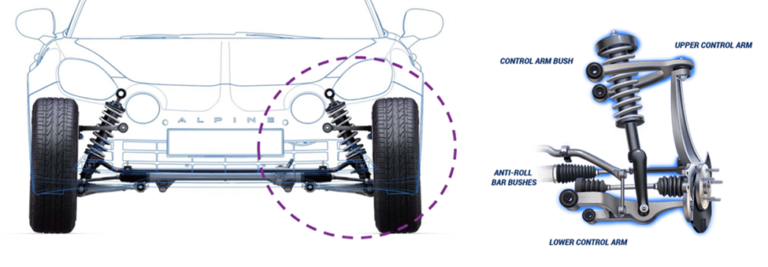
A stabilizer bar—also called a sway bar or anti-roll bar—is a suspension component designed to reduce lateral body roll (leaning) when a vehicle corners or travels over uneven road surfaces. It typically consists of a U-shaped steel (solid or hollow) bar that connects the suspension on the left and right sides, either to the lower control arms or struts.
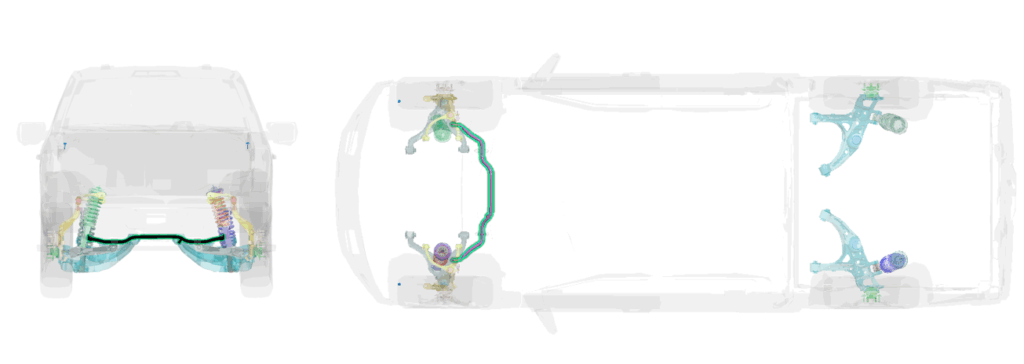
The stabilizer bar acts as a torsion spring: when one wheel moves upward relative to the other, the bar twists, resisting the motion. This twisting force reduces roll by transferring some of the load from the wheel on the outside of the turn to the wheel on the inside, keeping the vehicle more level. By distributing forces across the suspension, the bar improves stability and handling, giving drivers more confidence during cornering maneuvers.
The primary functions of a stabilizer bar include:
- Reducing body roll: Counteracts the tendency of the body to lean outward during turns.
- Improving handling: Provides a more stable and controlled ride by maintaining tire contact and balance.
- Connecting suspension sides: Links the left and right suspension systems to work in unison.
- Acting as a torsion spring: Stores and transfers energy through twisting motion to resist roll.
Without stabilizer bars, vehicles would exhibit excessive roll, reduced cornering ability, and higher rollover risk.
Rollover Risk and Vehicle Stability
One of the most dangerous failures is a vehicle rollover, where wheels lose contact with the road. Rollovers are particularly severe, often resulting in fatalities or total vehicle loss. Research indicates that rollovers have the highest fatality rate among road crashes, with fatal outcomes in up to 18% of cases.
Rollovers are classified into two categories: tripped rollovers, caused by curbs, soft soil, or roadside obstacles, and untripped rollovers, which occur due to steering maneuvers, sharp lateral accelerations, or speed.

Several factors influence rollover risk. External contributors include road curvature, uneven terrain, crosswinds, and adverse weather conditions. Internal contributors include vehicle design characteristics such as center of gravity height (a higher CG increases rollover tendency), track width (a narrower track lowers rollover threshold), vehicle speed, and steering input (sudden maneuvers unload inner wheels).
The Load Transfer Ratio (LTR) is often used to quantify rollover risk:
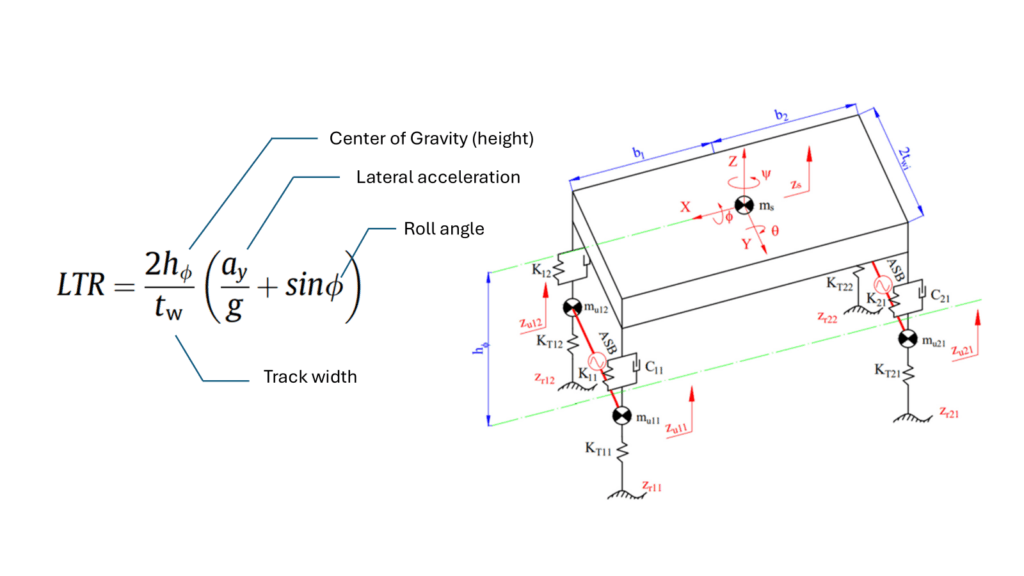
As LTR→ 1, the likelihood of wheel lift-off and rollover increases.
Stabilizer Bar Mechanics
As vehicle mass or center of gravity (CG) height increases, stabilizer bars must be upsized to achieve the same roll stiffness. The stiffness of the stabilizer bar scales with the second moment of area of its cross-section, meaning thicker or hollow bars significantly improve roll resistance.

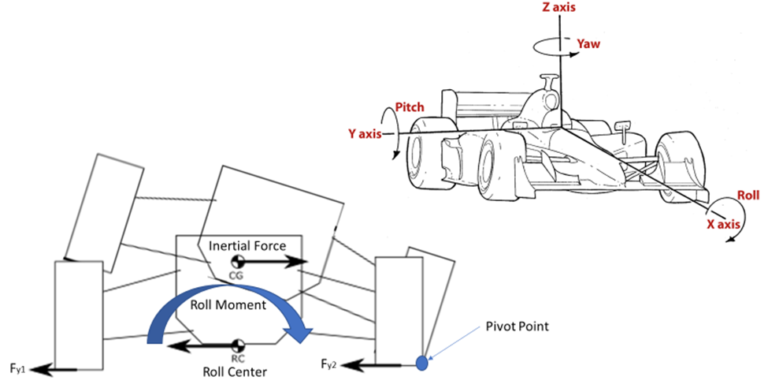
When the vehicle leans, the sway bar twists. This twisting resists roll and redistributes weight more evenly, keeping the vehicle upright. The relationship between roll angle and stabilizer bar performance can be expressed as:

where:
- mveh = vehicle sprung mass with passengers [kg]
- CGz= center of gravity height [m]
- Ksusp = suspension stiffness
- Ktire= tire stiffness
- g= gravitational acceleration
This shows that roll angle increases with vehicle mass and CG height but decreases with higher suspension/tire stiffness.
Different Types of Sway Bars
There are several types of sway bars, each with its own advantages and disadvantages. Solid sway bars are the most basic type and are typically made from solid steel. They are durable and inexpensive to manufacture, but they can be heavy and may transmit more noise and vibration to the vehicle’s cabin. Hollow sway bars are similar to solid sway bars but are hollowed out in the center to reduce weight. They offer a good balance of strength and weight, though they can be more expensive to manufacture than solid versions. Tubular sway bars are another lightweight option, made from a tube of steel or aluminum, and are both strong and effective, though they also tend to be more expensive than other designs.
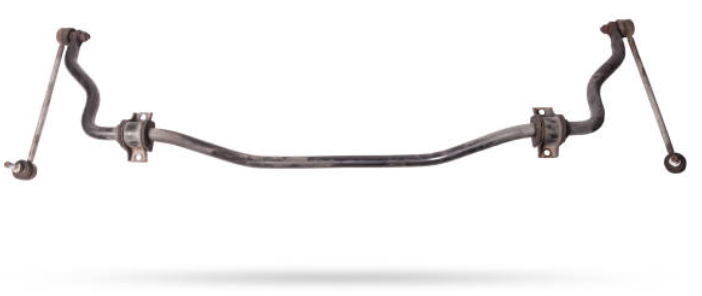
Adjustable sway bars are designed with a mechanism that allows the stiffness of the torsion spring to be fine-tuned. This provides flexibility for different driving conditions and styles. Drivers who seek better handling performance, particularly in motorsport or spirited driving, often prefer adjustable sway bars, even though they cost more than solid or hollow types. Split sway bars, while less common, provide the benefit of easier installation since they are divided in the middle, allowing them to be mounted without removing the entire suspension system.
Functional Categories and Applications
Beyond their structural differences, sway bars can also be categorized by their function. Mechanical (passive) sway bars are the most widely used due to their simple structure, compact size, and affordability, though their stabilizing efficiency is limited. Hydraulic and electronic sway bars, which fall under the category of active systems, are more advanced and can automatically adjust stiffness depending on driving conditions. These active stabilizer bars significantly improve ride comfort and handling, but are more complex and expensive.
Many vehicles are equipped with more than one sway bar, typically both front and rear, which may vary in size, shape, and stiffness. Performance-focused drivers often upgrade to aftermarket sway bars to improve cornering ability and reduce body roll. Adjustable aftermarket options are especially popular, as they allow for tailored handling characteristics, though the trade-off often involves reduced ride comfort.
Sway bar tuning
When tuning sway bars, engineers aim to balance two key factors: the total roll stiffness provided by both front and rear sway bars, and the roll distribution, which directly impacts stability. Increasing overall roll stiffness reduces body lean; however, the distribution of stiffness between the front and rear axles determines whether the car tends toward understeer, oversteer, or a more neutral balance. This balance is crucial in both everyday driving and motorsport applications.
Advantages and Drawbacks
The use of stabilizer bars brings several benefits. They reduce body roll, making the ride more comfortable and predictable for passengers while also improving cornering performance. By distributing lateral forces across the suspension, they enhance rollover resistance and improve vehicle stability in dynamic conditions.

However, they also have limitations. Adding stiffness in the roll reduces wheel independence, which can negatively affect ride quality on uneven surfaces. Passive systems in particular can compromise comfort when tuned for performance. Additionally, stabilizer bars add both weight and complexity to suspension systems, and the more advanced active or electronic designs significantly increase cost and system intricacy.
Conclusion
The stabilizer bar is a critical suspension component that directly affects vehicle stability, rollover resistance, and handling dynamics. From its origins in the early 20th century to today’s advanced electronic systems, the stabilizer bar has evolved into a key safety and performance feature. By resisting body roll, connecting suspension components, and acting as a torsion spring, it ensures that vehicles remain more upright and controlled during cornering. While active and adjustable systems continue to enhance stability in premium vehicles, even the simplest mechanical stabilizer bars remain vital in reducing roll angle and preventing rollover accidents.
Reference
- Abdelrahman, A. A., Mohammed, O. A., Zohdy, M. A., Mohamed, R. A., El-Shafie, M., & El-Sayed, A. (2022). A comprehensive review of vehicle active suspension control systems. Heliyon, 8(12), e11959. https://doi.org/10.1016/j.heliyon.2022.e11959
- Zhao, Y., He, H., Wang, X., Zhu, J., Zhang, Y., & Chen, H. (2023). Development trend of intelligent chassis technology. Automotive Innovation, 6(2), 155–178. https://doi.org/10.1007/s42154-023-00205-y


You really make it appear really easy along with your presentation however I find this matter to be actually one thing which I think I’d by no means understand. It kind of feels too complex and extremely wide for me. I’m having a look forward for your subsequent publish, I will attempt to get the dangle of it!