
Coil Springs in Automotive Suspensions
In automotive engineering, coil springs are among the most important elements of suspension systems, used in both front and rear assemblies. Their function is to absorb the impact energy transmitted from road irregularities, reducing oscillations passed to the vehicle body and enhancing passenger comfort. Because they operate primarily in the elastic regime, coil springs are expected to return to their original shape after countless cycles of loading. To meet this demand, they are typically manufactured from high-strength steels that provide both resilience and fatigue resistance.
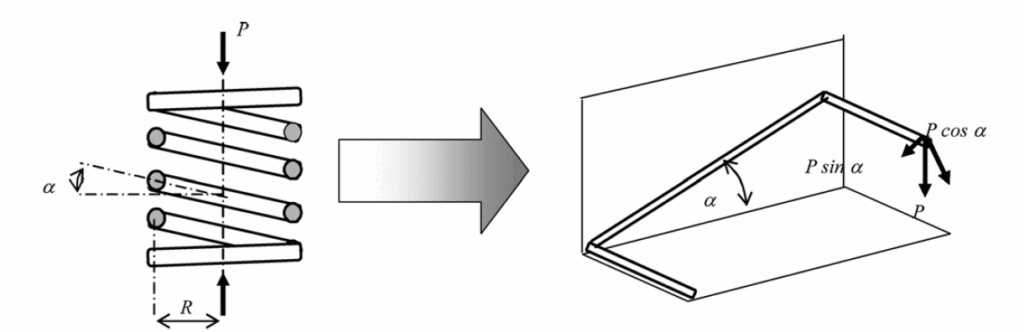
Modern spring design must also align with the broader goals of the automotive industry. As manufacturers continue to prioritize weight cutting to lower fuel/energy consumption and emissions, coil springs are subjected to higher stress levels than in past decades. This push for lighter yet stronger suspension systems makes material selection, manufacturing precision, and design optimization more critical than ever.
Although often overlooked by drivers, coil springs have a direct impact on ride comfort, handling stability, and long-term durability. The science behind their design is both intricate and essential, requiring careful integration of vehicle dynamics, materials engineering, and failure analysis.
This article examines why coil springs are indispensable in automotive suspensions, reviews the fundamental equations that guide their design, and highlights insights from failure analysis that demonstrate the importance of robust engineering practices.

Why Coil Springs Matter in Automotive Suspensions
Springs are one of the most crucial components of any suspension system because they determine how close or far the chassis sits from the road or track. Properly designed springs help prevent bottoming out, reduce body roll during cornering and acceleration, and minimize nose dive when braking, all of which play a vital role in how a vehicle handles.
When a car encounters a bump, the spring compresses to absorb the impact and then rebounds to release the stored energy. In an ideal scenario, the spring compresses and rebounds at a precise rate, smoothing out the disturbance so that the driver and passengers feel little to no shock.
Sprung vs Unsprung Mass
Before diving into spring design, it is essential to understand the concepts of sprung weight and unsprung weight. Sprung weight refers to the portion of the vehicle’s mass supported by the springs, which includes the body, frame, engine, and transmission. In contrast, unsprung weight consists of the components not supported by the springs, such as the tires, wheels, and brake assemblies.
Springs serve the crucial function of isolating the vehicle’s frame and body from road disturbances, while allowing the suspension and tires to follow the road’s contours. Reducing unsprung weight helps minimize road shock, resulting in smoother operation. A higher sprung weight, combined with a lower unsprung weight, generally leads to better ride comfort and improved tire traction.
Ride Comfort and Vehicle Dynamics
Coil springs are designed to absorb and store energy when a vehicle encounters bumps, potholes, or uneven terrain. By controlling the vertical motion of the wheels relative to the vehicle body, they significantly reduce the amount of road shock transmitted to passengers.
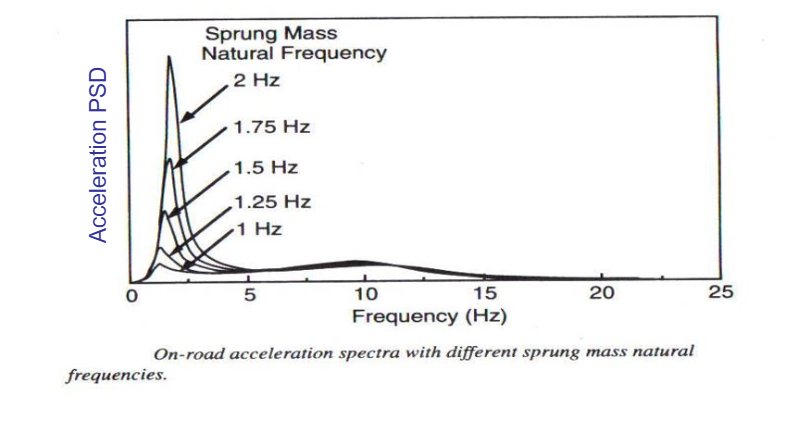
A key design target for suspension engineers is ride frequency, which determines how “soft” or “firm” a vehicle feels. Ride frequency is primarily set based on vehicle dynamics and comfort requirements: passenger cars typically use lower frequencies for comfort, while sports cars use higher frequencies for better handling. However, each automaker will set these targets based on its best practices.

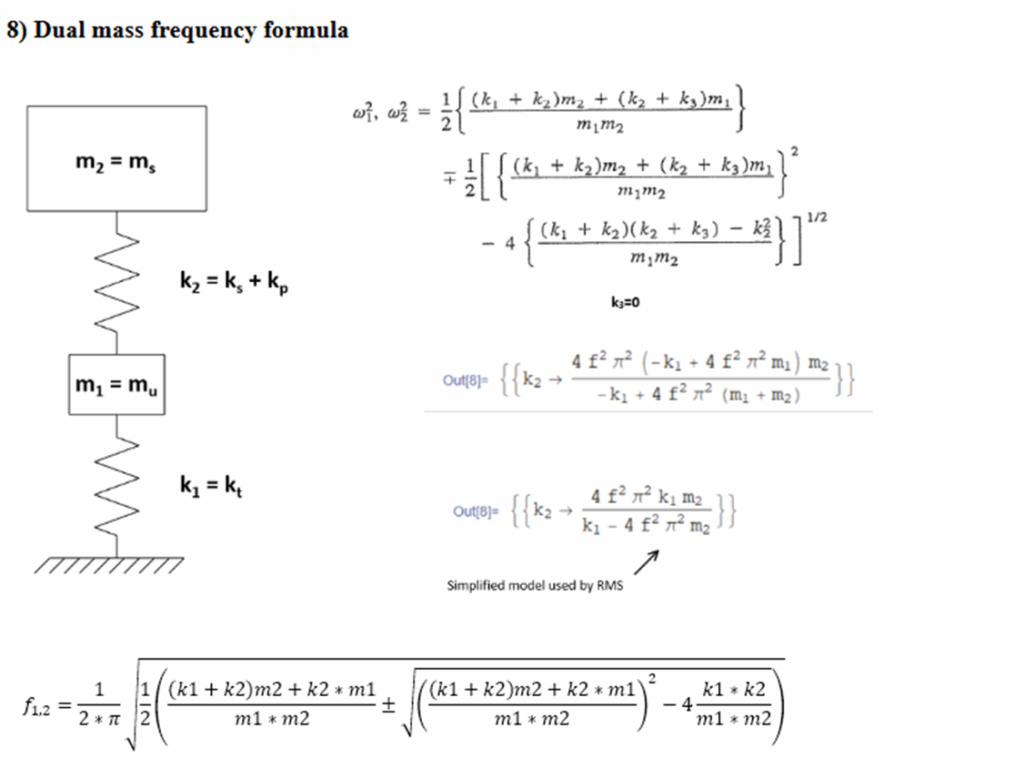
The simplified equation above does not take into account the unsprung mass of the vehicle or the tire stiffness. A more accurate, but significantly more complex representation is provided by the dual mass frequency formula, which incorporates the interaction between the sprung mass (ms), the unsprung mass (mu), the suspension spring stiffness (ks + kt), and the tire stiffness (kt) (see Figure below).
Load Support at Curb Weight
Coil springs must also support the vehicle’s static load (curb sprung weight) in conjunction with the shock absorbers. This load-sharing ensures that the suspension remains properly balanced, maintaining both ride height and predictable handling behavior.
Geometry Constraints and Jounce Limits
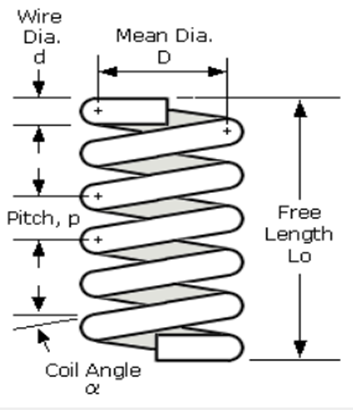
When the suspension is fully compressed (jounce), the spring geometry must prevent coil binding while maintaining proper clearance. This constraint drives key design parameters such as:
- Wire diameter (d)
- Mean coil diameter (D)
- Number of active coils (n)
- Free length of the spring
Incorrectly balancing these parameters can lead to premature spring fatigue or ride height issues.
Fundamental Equations in Spring Design
Today, four main types of springs are commonly used in vehicles: coil springs, leaf springs, torsion bars, and air springs.
Among these, the coil spring is the most widely used. It is made from a round steel rod wound into a helical shape. Unlike leaf springs, coil springs do not produce interleaf friction, which allows them to deliver a smoother and more comfortable ride.
Spring Rate (Kspring)
Spring rate, also called the deflection rate, is a measure of a spring’s stiffness and represents the amount of force required to compress the spring by one inch. For example, if it takes 100 pounds to compress a spring by one inch, then 200 pounds would be needed to compress it by two inches. The spring rate is determined primarily by the geometry of the coil spring, including the rod’s length and diameter, the number of active coils, and the spacing between them. Reducing the rod diameter, coil count, or coil spacing increases stiffness, while increasing these factors decreases it.
Mathematically, the spring rate can be expressed as:

Where:
- G = Shear modulus of the spring material
- d = Wire diameter
- D = Mean coil diameter
- n = Number of active coils
This equation highlights the strong influence of wire diameter, which scales to the fourth power, making it the most sensitive design parameter.
Variable Spring Rate
Some coil springs are designed with a variable rate. This effect can be achieved either by using a wire of varying thickness along the spring or by winding the coils so that certain sections progressively bottom out under load. Variable-rate springs offer the benefit of a softer spring rate when the vehicle is lightly loaded, resulting in a smoother ride, while providing a stiffer rate under heavier loads, delivering greater support and improved control.

Higher Spring Rates
Using a higher spring rate gives the suspension a firmer feel. Race car drivers often prefer stiffer springs because they help reduce body roll and lean, while also allowing the car to run with lower ground clearance and a lower center of gravity. On smooth racing surfaces, the risk of bottoming out and damaging the chassis is minimal, making stiffer springs an effective choice.
From an aerodynamic standpoint, lower ground clearance means less air flows beneath the vehicle, which helps keep it closer to the track. Downforce also plays a role: as aerodynamic loads press the vehicle downward, ride height can change. Stiffer springs counteract these forces, helping the car maintain a more consistent ride height.
However, there are trade-offs. Springs that are too stiff can significantly reduce ride quality, and on bumpy or uneven roads, the tires may lose contact with the surface, reducing grip and overall performance.
Lower Spring Rates
Lower spring rates, on the other hand, result in a softer suspension feel and generally provide more grip. Softer springs allow the tires to maintain better contact with the road over bumps and curbs, which can improve traction compared to a stiffer setup.
Ultimately, the choice between higher and lower spring rates depends on your driving conditions and preferences. Engineering principles provide the framework, but finding the right balance of stiffness and compliance requires considering whether ride comfort, grip, or precision handling is the top priority.
Spring Shear Stress (τ)
Spring durability depends on the maximum shear stress within the wire, which must remain below the fatigue limit of the material:
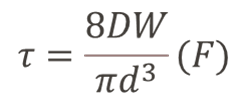
Where:
- F = Normal force acting on the spring at the curb mass
- W = Wahl factor (accounts for stress concentration due to coil curvature)

Materials and Manufacturing Considerations
Coil springs are typically made from high-strength martensitic steels, such as SAE 9254, with design stress levels that have nearly doubled over the past century—from ~500 MPa in early springs to over 1200 MPa in modern designs.
Advanced manufacturing techniques such as shot peening (to induce beneficial residual stresses) and controlled heat treatment are used to enhance fatigue life. However, as spring stress levels increase, material cleanliness and surface quality become critical to avoiding failures.
Common Failure Modes of Coil Springs
Coil springs generally require no adjustment and are considered highly reliable. The most common issue they experience is spring sag. When springs settle below the vehicle’s design ride height, the suspension geometry is altered, which can lead to uneven tire wear, poor handling, and accelerated wear of other suspension components.
For this reason, measuring ride height during suspension service is essential. If the measurements fall outside the manufacturer’s specifications, the springs should be replaced.
Insights from Failure Analysis
Extensive research has shown that spring failures can occur due to several root causes:
- Material defects: Non-metallic inclusions or abnormal microstructures that act as crack initiation sites.
- Surface imperfections: Inadequate shot peening or tool marks from manufacturing that shorten fatigue life.
- Heat treatment errors: Issues during quenching or tempering that result in brittle phases or decarburized layers.
- Corrosion: Damage to protective coatings that allows pitting corrosion, accelerating fatigue.
- Forging defects: As identified in recent studies, improper radial forging can leave helical surface marks that serve as stress risers.
To better understand these failure mechanisms, Finite Element Analysis (FEA) has proven to be a valuable tool, allowing engineers to model stress concentrations around defects and predict how they may affect durability.
Conclusion
Coil springs are far more than simple metal coils; they are highly engineered components critical to vehicle safety, comfort, and performance. Their design requires balancing stiffness, ride quality, and durability using a combination of classical equations and advanced analysis techniques.
Understanding the role of material properties, manufacturing quality, and failure modes is essential for ensuring that springs perform reliably throughout a vehicle’s life. As vehicles continue to evolve with lightweight materials and electrification, the demands placed on coil springs will only increase, making their design and analysis more important than ever.
References
- Prawoto, Y., Ikeda, M., Manville, S.K., & Nishikawa, A. (2008). Design and failure modes of automotive suspension springs. Engineering Failure Analysis, 15(2008), 1155–1174. https://doi.org/10.1016/j.engfailanal.2007.11.003
- Bergh, F., Silva, G.C., Silva, C., & Paiva, P. (2021). Analysis of an automotive coil spring fracture. Engineering Failure Analysis, 129 (2021), 105679. https://doi.org/10.1016/j.engfailanal.2021.105679
- Wahl, A.M. (1984). Mechanical Springs. McGraw-Hill Book Company.




I’ve recently started a website, the information you offer on this web site has helped me tremendously. Thank you for all of your time & work.