
Automotive Ignition System Explained: Electronic Ignition Control, Types & Components
Introduction
The automotive ignition system is designed to ignite the fuel-air mixture in gasoline engines. In spark-ignition versions of internal combustion engines, the ignition system generates a spark to ignite the fuel-air mixture just before each combustion stroke. Unlike the automotive ignition system, the ignition system used in gas turbine engines and rocket engines is typically only used during start-up.
Diesel engines utilize compression ignition, igniting the fuel-air mixture using the heat of compression, and thus do not require the typical ignition system found in gasoline engines. They often feature glow plugs that preheat the combustion chamber to assist starting in cold conditions.

Early automobiles utilized ignition magnetos and trembler coil systems, which were later replaced by distributor-based systems (first introduced in 1912). Electronic ignition systems (first used in 1968) became prevalent toward the end of the 20th century, as part of a broader shift toward computer-controlled vehicle systems, with coil-on-plug versions of these systems becoming widespread since the 1990s.
What Is an Automotive Ignition System?
The primary function of an automotive ignition system is to ignite the air-fuel mixture within a gasoline engine. Apart from the spark plugs that create sparks within the combustion chambers, the ignition system comprises an ignition coil, which elevates battery voltage to a higher level, and the spark plug wires that connect these elements. Although there is a wide variety of ignition systems available today, most can be categorized into one of three broad groups:
- Conventional breaker-point ignition (used since the early 1900s)
- Electronic ignition (popular since the early 1970s)
- Distributorless ignition (introduced in the mid-1980s)

Port-Fuel Injection (PFI) vs. Gasoline Direct-Injection (GDI)
The port-fuel injection (PFI) system has been widely utilized in gasoline engines and has seen decades of improvement. Although the gasoline direct-injection (GDI) system has gained popularity recently for various significant reasons, interest in the PFI system has resurfaced due to its superior ability to reduce particulate number (PN) emissions. Studies have identified a significant amount of particulate matter emissions from GDI engines.

Some studies have proposed fuel blending with either gaseous or higher-octane fuels to improve combustion and reduce emissions in gasoline engines. Additionally, cold-start performance has become more critical due to the increasing frequency of engine restarts in advanced powertrain applications, driven by stop-start systems used on mild-hybrid powertrains. Gasoline PFI engines often produce high CO and HC emissions during cold starts because of a rich air/fuel mixture, lower catalyst conversion efficiency, and poor fuel economy from increased friction and incomplete combustion. As a result, efforts have been made to enhance PFI gasoline engines with advanced injection systems.
What Does the Ignition System Circuit Do?
The ignition circuit is an example of a second-order RLC circuit. It is responsible for producing and delivering the electrical spark needed to ignite the fuel-air mixture in an engine’s cylinders. It consists of components like the ignition coil, distributor (or electronic control unit), spark plug wires, and spark plugs to form a spark at the air gap and ignite the gas-air mixture.

When the switch is closed, the primary of the transformer is charged with current. When the switch is open, the current is interrupted and the energy stored in the primary is transferred to the secondary.
Breaker-Point (Distributor-Based) Ignition Systems
Back in the old days, cars used a point/distributor-based ignition system. This system relied on a mechanical method to open and close the circuit (make and break the primary circuit) that delivered the spark to the engine.
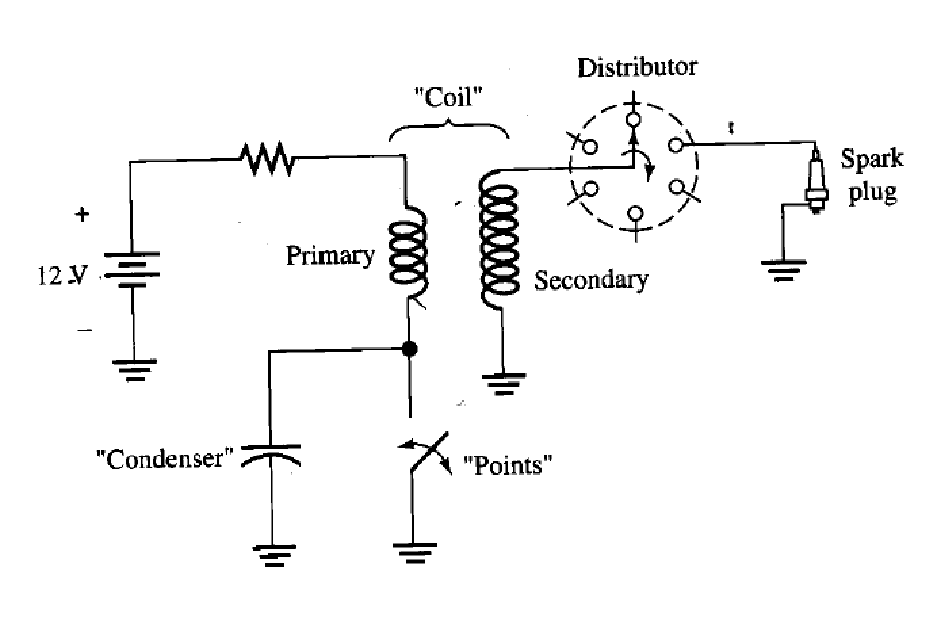
This system consisted of a distributor, a rotor, and ignition points. The distributor rotates and distributes high-voltage electrical current from the ignition coil to each spark plug in the correct firing order. The ignition points open and close to trigger the spark at the right time.
Modern vehicles have largely replaced distributor-based systems with more advanced electronic ignition control systems for improved reliability and performance. The main drawbacks of an older distributor-based ignition system are that it required frequent maintenance to keep the points clean and properly adjusted, and it wasn’t very reliable in wet or humid conditions.
Simulation of an Ignition Circuit Using PSIM

Results of a PSIM simulation:

Other Types of Automotive Ignition Systems
Breaker-point ignition was just the starting point. As automotive engineering advanced, several other ignition designs were developed to improve reliability, performance, and emissions.
Electronic Ignition (High-Energy Ignition)
Electronic ignition replaces the mechanical breaker points with solid-state electronics, using a magnetic pickup or Hall-effect sensor to trigger the spark instead of physical contacts. This eliminates point wear and the need for periodic gap adjustment, resulting in more consistent timing and a hotter, more reliable spark.
Distributorless Ignition (DIS)
A distributorless ignition system removes the rotating distributor entirely. Instead, a coil pack fires two spark plugs at once, one on the compression stroke and one on the exhaust stroke (a “waste spark”), with an electronic control module handling all timing.

Coil-on-Plug (COP) Ignition
Coil-on-plug ignition takes distributorless designs a step further by mounting an individual coil directly on top of each spark plug. This shortens the high-voltage path, reduces electromagnetic interference, and allows the engine control unit to fire each cylinder independently for maximum precision.
Magneto Ignition
Magneto ignition systems generate their own spark voltage using a rotating magnet and coil, without relying on the vehicle’s battery. Because they’re self-powered, magnetos are still common on small engines, aircraft piston engines, and some racing applications where battery independence matters.
Comparing Ignition System Types
| Type | Era Introduced | Pros | Cons |
|---|---|---|---|
| Breaker-point (distributor) | Early 1900s | Simple, inexpensive, easy to diagnose and repair | Many moving parts, frequent maintenance, unreliable in wet/humid conditions |
| Electronic (HEI) | Early 1970s | More reliable spark, no point wear, less maintenance | More costly to repair than points if electronics fail |
| Distributorless (DIS) | Mid-1980s | Improved reliability, no distributor to wear out | More expensive than breaker-point systems |
| Coil-on-plug (COP) | Widespread since 1990s | Most reliable, best performance, minimal interference | Highest parts cost, one coil failure per cylinder |
| Magneto | Earliest automobiles; still used today | Self-powered, no battery dependency | Limited to small engines, aircraft, and specialty uses |
Components of an Electronic Ignition Control System
Electronic ignition control systems were developed to address the reliability issues of breaker-point designs. These systems use solid-state electronics to control the timing and delivery of the spark, eliminating the need for mechanical switches and improving efficiency. In a typical four-stroke engine, one cylinder is in its compression stroke, where the spark ignites the air-fuel mixture, while a paired cylinder is not in compression and is unaffected by the spark. Engines are normally built with an even number of cylinders (4, 6, or 8), which is why this pairing approach works well.

There are a few main components that work together to produce and deliver the spark to the engine: the ignition coil, the distributor (or controller), the spark plug wires, and the spark plugs.
The ignition coil converts the 12-volt electrical current from the battery into the high-voltage current required to produce the spark. It achieves this by sending a large current through an inductance and interrupting it after building up in the primary circuit. This interruption induces a very high voltage in the secondary of the coil, which is connected to the spark plug terminals.

The distributor is a rotating part that distributes the spark to the correct spark plug at the right time, based on the firing order of the engine. The spark plug wires connect the distributor to the spark plugs, delivering the spark to each plug, and the spark plugs themselves are responsible for actually igniting the fuel in the engine.

How Electronic Ignition Control Systems Work
Now that we understand the components of the system, let’s talk about how electronic ignition control systems actually work. Internal combustion engines depend on spark timing being precisely matched to engine position during the compression stroke.
The system uses a series of sensors to determine the engine’s position (relative to top dead center, or TDC), speed (RPM), manifold pressure, and engine temperature. It then uses this information to trigger the spark at the right time. Electronic ignition can be part of an integrated system or a stand-alone ignition system.

All electronic ignition control systems work in roughly the same way, whether they’re distributor-based, distributorless, or coil-on-plug — see the comparison table above for how each design’s pros and cons stack up.
What Is Electronic Engine Control (EEC)?
The Electronic Engine Control (EEC) system utilizes sensor data on engine position, mass air flow, manifold pressure, and RPM to calculate the correct spark advance for each cylinder. The controller then sends a signal to the corresponding ignition driver circuit, initiating the spark. In many modern electronic spark systems, spark plugs are fired in pairs through a common coil or high-voltage transformer. This technology replaces older mechanical systems, such as carburetors and distributor points, with computer-controlled systems that offer more precise and efficient control over the engine’s operation.
Benefits of Electronic Ignition Control Systems
Electronic ignition control systems offer a number of benefits over traditional points-based ignition systems. For one thing, they’re more reliable and require less maintenance. They also offer improved fuel efficiency and reduced emissions, which is good for both the environment and your wallet. And perhaps most importantly, they offer increased power and performance, which is always a good thing for car enthusiasts.

Symptoms and Common Problems With Ignition Systems
Like any complex system, electronic ignition control systems can encounter problems from time to time. Fortunately, many of these problems have relatively simple diagnoses and fixes. Common warning signs include:
- Engine misfires — a rough, uneven idle or a noticeable stumble under acceleration, often caused by a worn spark plug or a failing ignition coil
- Poor fuel economy — incomplete combustion from weak or mistimed sparks wastes fuel
- Stalling — an intermittent loss of spark can cause the engine to die unexpectedly, especially at idle
- Hard starting or no-start conditions — a failed ignition coil, module, or crank/cam position sensor can prevent spark delivery altogether
- Backfiring or popping — spark firing at the wrong point in the cycle can ignite fuel outside the combustion chamber
On modern vehicles, a misfire or ignition fault typically triggers a check-engine light with an OBD-II diagnostic trouble code in the P0300 range — P0300 indicates a random or multiple-cylinder misfire, while P0301 through P0308 identify a misfire on a specific cylinder. A scan tool that reads these codes, combined with a spark tester or multimeter check of coil resistance, is usually enough to narrow a problem down to a bad spark plug, a failing ignition coil, or a wiring/sensor fault.
Ignition System Maintenance and Replacement Costs
Because electronic ignition systems have far fewer wear parts than old breaker-point designs, they need much less routine maintenance. Even so, a few components still wear out over time and are worth budgeting for:
- Spark plugs — typically replaced every 30,000–100,000 miles depending on the plug material (copper, platinum, or iridium); parts generally run in the low tens of dollars per plug
- Ignition coils — on coil-on-plug systems, coils are replaced individually as they fail rather than on a fixed schedule
- Distributor cap and rotor — only relevant on older distributor-based vehicles; these wear from arcing and are usually replaced together
Labor costs vary widely by vehicle and shop, so it’s worth getting a quote for your specific make and model rather than relying on general estimates.
Conclusion
In conclusion, the automotive ignition system is a vital component of any modern car. Understanding how it works is crucial for anyone who wants to keep their vehicle running smoothly. By using solid-state electronics to control the timing and delivery of the spark, these systems offer improved reliability, efficiency, and performance over traditional points-based ignition systems. And while they can experience problems from time to time, many of these issues can be diagnosed and fixed with relative ease.
Frequently Asked Questions
What are the main types of automotive ignition systems?
The five main types are breaker-point (distributor-based), electronic (high-energy) ignition, distributorless ignition (DIS), coil-on-plug (COP) ignition, and magneto ignition. Most modern vehicles use coil-on-plug systems.
What is the difference between a distributor-based and a distributorless ignition system?
A distributor-based system uses a single rotating distributor to route high-voltage spark to each plug in firing order. A distributorless system replaces the distributor with one or more coil packs controlled electronically, improving reliability and reducing moving parts.
What are the symptoms of a failing ignition system?
Common symptoms include engine misfires, rough idle, poor fuel economy, stalling, hard starting, and backfiring. A check-engine light with a P0300-series diagnostic code usually points to a misfire caused by a worn spark plug or failing ignition coil.
How much does it cost to replace an ignition coil?
Costs vary by vehicle make, model, and number of cylinders, since coil-on-plug systems use one coil per cylinder. It’s best to get a quote from a mechanic for your specific vehicle.
Do diesel engines have an ignition system?
No. Diesel engines use compression ignition, where the heat generated by compressing air ignites the fuel-air mixture, so they don’t require spark plugs or an ignition system in the gasoline-engine sense. They typically use glow plugs to aid cold starts instead.
Discover more from Engineering Cheat Sheet
Subscribe to get the latest posts sent to your email.


