
Heat Transfer Practice Problems with Solutions (20 Worked Examples)
This page collects 20 original heat transfer practice problems with complete worked solutions. They cover the three modes of heat transfer (conduction, convection and radiation), combined modes and energy balances, and conduction with internal heat generation. Each solution is typed step by step with the governing equation, the numbers substituted and a check where one is available. For lab-style examples, see the radial heat conduction experiment and the forced convection experiment.
Heat transfer formula cheat sheet
| Mode | Rate equation | Notes |
|---|---|---|
| Conduction (plane wall) | q″ = k(T₁ − T₂)/L | Fourier’s law; k in W/m·K |
| Conduction (cylinder) | q′ = 2πk(T₁ − T₂)/ln(r₂/r₁) | Per metre of length |
| Convection | q″ = h(Ts − T∞) | Newton’s law of cooling |
| Radiation (to large surroundings) | q″ = εσ(Ts4 − Tsur4) | σ = 5.67×10⁻⁸ W/m²·K⁴; absolute temperatures |
| Thermal resistance | R″ = L/k, 1/h, 1/hr | Resistances in series add |
| Lumped capacitance | (T − T∞)/(Ti − T∞) = exp(−t/τ) | Valid when Bi = hLc/k < 0.1 |
| Heat generation (wall, one side insulated) | Tmax − Ts = q̇L²/2k | Maximum at the insulated face |
| Heat generation (solid cylinder) | T(0) − Ts = q̇ro²/4k | Maximum on the axis |
Conduction and thermal resistance
Conduction problems apply Fourier’s law layer by layer. Treat each layer or surface film as a thermal resistance, add them in series, and then work back through the network to find temperatures.
Problem 1: Thermal conductivity from a measured heat flux
Problem. The heat flux through an 80 mm thick slab of insulating board is measured as 25 W/m². The two faces are held at 35 °C and 5 °C. Find the thermal conductivity of the board.
Solution.
- Apply Fourier’s law for one-dimensional steady conduction through a plane wall: q″ = k(T₁ − T₂)/L.
- Solve for k: k = q″L/(T₁ − T₂) = (25)(0.08)/(35 − 5) = 2.00/30.
- k = 0.0667 W/m·K, which is in the range of rigid fibre insulation boards.
Answer. k ≈ 0.067 W/m·K
Problem 2: Heat loss through a composite wall
Problem. A wall consists of 100 mm of brick (k = 0.72 W/m·K), 50 mm of foam insulation (k = 0.04 W/m·K) and 15 mm of plaster (k = 0.5 W/m·K), in that order from inside to outside. The inside surface is at 22 °C and the outside surface is at −8 °C. Find the heat flux and the temperature at each interface.
Solution.
- Each layer is a thermal resistance per unit area, R″ = L/k, and the layers add in series.
- Brick: 0.1/0.72 = 0.1389 m²·K/W. Foam: 0.05/0.04 = 1.2500 m²·K/W. Plaster: 0.015/0.5 = 0.0300 m²·K/W.
- Total R″ = 1.4189 m²·K/W, so q″ = (22 − (−8))/1.4189 = 21.14 W/m².
- Brick–foam interface: T = 22 − 21.14(0.1389) = 19.06 °C.
- Foam–plaster interface: T = 19.06 − 21.14(1.2500) = −7.37 °C.
- Check: −7.37 − 21.14(0.0300) = −8.00 °C, which matches the outside surface temperature.
Answer. q″ ≈ 21.1 W/m²; interface temperatures ≈ 19.1 °C and −7.4 °C. Almost all of the temperature drop is across the foam.
Problem 3: Overall heat transfer coefficient and building heat loss
Problem. The wall of Problem 2 now separates room air at 21 °C from outdoor air at −5 °C. The inside convection coefficient is 8 W/m²·K and the outside coefficient is 25 W/m²·K. Find the overall heat transfer coefficient U and the heat loss through 12 m² of wall.
Solution.
- Add the convection resistances in series with the conduction layers: R″total = 1/hi + ΣL/k + 1/ho.
- 1/hi = 0.1250; ΣL/k = 1.4189; 1/ho = 0.0400. The total is 1.5839 m²·K/W.
- U = 1/R″total = 0.631 W/m²·K.
- Q = UA(Tin − Tout) = (0.631)(12)(21 − (−5)) = 197 W.
Answer. U ≈ 0.63 W/m²·K and Q ≈ 197 W
Problem 4: Insulated steam pipe
Problem. A steam pipe has an outer radius of 30 mm and carries steam so that the pipe surface is at 150 °C. It is wrapped with insulation of conductivity 0.06 W/m·K out to a radius of 50 mm, and the outer surface of the insulation is at 30 °C. Find the heat loss per metre of pipe.
Solution.
- For steady radial conduction in a hollow cylinder, q′ = 2πk(T1 − T2)/ln(r2/r1).
- ln(r2/r1) = ln(0.05/0.03) = 0.5108.
- q′ = 2π(0.06)(150 − 30)/0.5108 = 88.6 W/m.
- Equivalent thermal resistance per metre: R′ = ln(r2/r1)/(2πk) = 1.355 m·K/W, and 120/1.355 gives the same 88.6 W/m.
Answer. q′ ≈ 89 W/m
Problem 5: Critical radius of insulation on a thin wire
Problem. A bare wire of radius 4 mm carries current and its surface is held at 80 °C in air at 20 °C with h = 10 W/m²·K. A plastic coating with k = 0.17 W/m·K is proposed. Find the critical radius, and compare the heat loss per metre for the bare wire, for a coating out to the critical radius and for a coating out to 50 mm. At what outer radius does the coating finally reduce the loss below the bare-wire value?
Solution.
- For a cylinder the critical radius is rcr = k/h = 0.17/10 = 0.017 m = 17 mm.
- The wire radius (4 mm) is less than rcr, so adding coating first increases the heat loss.
- Bare wire: q′ = h(2πr0)(Tw − T∞) = 15.08 W/m.
- Coating to r = 17 mm: q′ = (Tw − T∞)/[ln(r/r0)/(2πk) + 1/(h·2πr)] = 26.19 W/m.
- Coating to r = 50 mm: q′ = 22.36 W/m, still above the bare-wire value.
- Setting q′ equal to the bare-wire loss and solving numerically shows that the coating only becomes a net insulator beyond r ≈ 263 mm.
Answer. rcr = 17 mm. Heat loss: bare 15.1 W/m, at rcr 26.2 W/m (the maximum), at 50 mm 22.4 W/m. A thin coating on a small wire helps cool it; it only insulates once the outer radius exceeds about 263 mm.
Convection heat transfer
Convection problems need a heat transfer coefficient. Either it is given, it comes from an energy balance on the object, or it is calculated from a Nusselt number correlation after checking the Reynolds number.
Problem 6: Newton’s law of cooling for a hot plate
Problem. A flat plate 0.5 m by 0.5 m has a surface temperature of 90 °C and is cooled on one face by air at 20 °C with h = 25 W/m²·K. Find the convective heat transfer rate and the heat flux.
Solution.
- Newton’s law of cooling: q″ = h(Ts − T∞).
- q″ = 25(90 − 20) = 1,750 W/m².
- Area A = 0.5 × 0.5 = 0.25 m², so q = q″A = 1,750 × 0.25 = 437.5 W.
Answer. q″ = 1,750 W/m² and q = 438 W
Problem 7: Free convection coefficient from a cooling plate
Problem. A thin aluminum plate, 0.3 m × 0.3 m, hangs vertically in still air at 20 °C. It has a mass of 1.2 kg and a specific heat of 900 J/kg·K. When its temperature is 70 °C it is observed to cool at 0.058 K/s. Neglect radiation and find the average free convection coefficient.
Solution.
- The plate is thin and highly conductive, so treat it as one lump at temperature T. The energy balance is m cp dT/dt = −h(2A)(T − T∞), with both faces exposed.
- Surface area of both faces: 2A = 2(0.3)(0.3) = 0.18 m².
- h = m cp|dT/dt|/[2A(T − T∞)] = (1.2)(900)(0.058)/[(0.18)(50)] = 62.64/9.00 = 6.96 W/m²·K.
- This is a typical natural convection value for air. Including radiation would lower the convection coefficient inferred from the same data.
Answer. h ≈ 7.0 W/m²·K
Problem 8: Average versus local coefficient on a plate
Problem. For turbulent flow over a flat plate, the local Nusselt number is correlated by Nux = 0.0296 Rex0.8 Pr1/3. Find the ratio of the average coefficient over length L to the local coefficient at x = L, and compute the average coefficient if hL = 48 W/m²·K.
Solution.
- Since Rex = ux/ν, the local coefficient varies as hx = C x−0.2, where C collects all the constants.
- The average over 0 to L is h̄L = (1/L)∫0L C x−0.2 dx = (C/L)(L0.8/0.8) = C L−0.2/0.8.
- Dividing by the local value at x = L, hL = C L−0.2, gives h̄L/hL = 1/0.8 = 1.25.
- h̄L = 1.25(48) = 60 W/m²·K.
Answer. h̄L/hL = 1.25, so h̄L = 60 W/m²·K. For a laminar boundary layer, where h ∝ x−1/2, the ratio is 2.
Problem 9: Heated cylinder in cross-flow
Problem. Air at 20 °C flows at 5 m/s across a long cylinder of diameter 25 mm whose surface is held at 90 °C. Use ν = 15.89×10⁻⁶ m²/s, k = 0.0263 W/m·K and Pr = 0.707. With Hilpert’s correlation NuD = C ReDm Pr1/3 (C = 0.193, m = 0.618 for 4,000 < ReD < 40,000), find h and the heat loss per metre.
Solution.
- ReD = VD/ν = (5)(0.025)/(15.89×10⁻⁶) = 7,867, which is inside the range of the correlation.
- NuD = 0.193(7,867)0.618(0.707)1/3 = 44.0.
- h = NuD k/D = (44.0)(0.0263)/0.025 = 46.2 W/m²·K.
- q′ = h(πD)(Ts − T∞) = (46.2)(π × 0.025)(90 − 20) = 254 W/m.
Answer. h ≈ 46 W/m²·K and q′ ≈ 254 W/m
Problem 10: Maximum power of an air-cooled chip
Problem. A square chip, 15 mm on a side, is cooled on its top face by air at 25 °C flowing parallel to it at 8 m/s. The chip temperature may not exceed 75 °C. Assuming laminar flow and negligible radiation, find the maximum allowable chip power. Use ν = 15.89×10⁻⁶ m²/s, k = 0.0263 W/m·K and Pr = 0.707.
Solution.
- ReL = VL/ν = (8)(0.015)/(15.89×10⁻⁶) = 7,552, far below the transition value of 5×10⁵, so the laminar average correlation applies.
- NuL = 0.664 ReL1/2 Pr1/3 = 0.664(7,552)1/2(0.707)1/3 = 51.4.
- h̄ = NuL k/L = (51.4)(0.0263)/0.015 = 90.1 W/m²·K.
- q = h̄A(Ts − T∞) = (90.1)(0.015)²(75 − 25) = 1.01 W.
Answer. Maximum chip power ≈ 1.01 W. A turbulence promoter at the leading edge would raise h̄ and allow more power.
Thermal radiation
Radiation depends on the fourth power of absolute temperature, so convert to kelvin before you start. For a small surface in large surroundings the surroundings temperature is all you need.
Problem 11: Surface temperature of a space probe
Problem. A spherical probe of diameter 0.4 m dissipates 120 W of electronics inside it. The surface emissivity is 0.85, and the probe receives no radiation from the sun or other bodies. What is the equilibrium surface temperature?
Solution.
- At steady state all the electrical power leaves by emission: P = εσAsTs4, where the surroundings (deep space) are effectively at 0 K.
- Surface area: As = πD² = π(0.4)² = 0.5027 m².
- Ts4 = P/(εσAs) = 120/[(0.85)(5.67×10⁻⁸)(0.5027)] = 4.953×10⁹ K4.
- Ts = 265.3 K = −7.9 °C.
Answer. Ts ≈ 265 K (−8 °C)
Problem 12: Net radiation to large surroundings and the radiation coefficient
Problem. A surface of area 0.5 m² and emissivity 0.8 is at 420 K inside a large room whose walls are at 300 K. Find the net radiation heat transfer rate and the equivalent radiation heat transfer coefficient hr.
Solution.
- For a small surface in large surroundings, qrad = εσA(Ts4 − Tsur4).
- Ts4 = 3.112×10¹⁰ K4; Tsur4 = 8.100×10⁹ K4.
- qrad = (0.8)(5.67×10⁻⁸)(0.5)(2.302×10¹⁰) = 522 W.
- Linearize: hr = εσ(Ts + Tsur)(Ts2 + Tsur2) = 8.70 W/m²·K.
- Check: hrA(Ts − Tsur) = (8.70)(0.5)(120) = 522 W.
Answer. qrad ≈ 522 W and hr ≈ 8.7 W/m²·K
Problem 13: Convection and radiation from a hot panel
Problem. A panel at 80 °C stands in a room where the air and walls are at 20 °C. The panel has an emissivity of 0.9 and a convection coefficient of 10 W/m²·K. Find the convective and radiative heat fluxes and the fraction of the total that is radiation.
Solution.
- Both modes act in parallel from the same surface: q″ = q″conv + q″rad.
- Convection: q″conv = h(Ts − T∞) = 10(80 − 20) = 600 W/m².
- Radiation (absolute temperatures 353.15 K and 293.15 K): q″rad = εσ(Ts4 − Tsur4) = (0.9)(5.67×10⁻⁸)(8.169×10⁹) = 417 W/m².
- Total = 1017 W/m², and radiation is 41% of it.
Answer. q″conv ≈ 600 W/m², q″rad ≈ 417 W/m²; radiation is about 41% of the total, so it cannot be neglected for a high-emissivity surface in air.
Problem 14: Radiation between parallel plates and the effect of a shield
Problem. Two large parallel plates are at 500 K (ε = 0.8) and 300 K (ε = 0.4). Find the net radiation flux between them. Then a thin shield with ε = 0.1 on both sides is placed between them; find the new flux.
Solution.
- For two large parallel gray surfaces: q″ = σ(T14 − T24)/(1/ε1 + 1/ε2 − 1).
- σ(T14 − T24) = (5.67×10⁻⁸)(6.250×10¹⁰ − 8.100×10⁹) = 3,084 W/m².
- Denominator: 1/0.8 + 1/0.4 − 1 = 2.75. So q″ = 1,122 W/m².
- With the shield there are two gaps in series. The resistance is (1/0.8 + 1/0.1 − 1) + (1/0.1 + 1/0.4 − 1) = 10.25 + 11.50 = 21.75.
- q″shield = 3,084/21.75 = 142 W/m².
Answer. Without the shield q″ ≈ 1,122 W/m²; with it q″ ≈ 142 W/m², a reduction of 87%.
Energy balances and combined modes
These problems combine modes. Write the energy balance first, then replace each term by its rate equation. When the balance is nonlinear, solve by iteration.
Problem 15: Surface temperature of a gearbox housing
Problem. A gearbox housing, a cube 0.3 m on a side with five exposed faces, receives 30 hp from the engine and delivers 95% of it to the output shaft. The remaining power is lost as heat through the housing to air and surroundings at 300 K. The convection coefficient is 12 W/m²·K and the surface emissivity is 0.8. Find the steady surface temperature.
Solution.
- Input power: 30 hp × 745.7 W/hp = 22,371 W. Heat loss = (1 − η)P = 0.05 × 22,371 = 1,119 W.
- Exposed area A = 5(0.30)² = 0.45 m².
- Steady-state energy balance: loss = hA(Ts − T∞) + εσA(Ts4 − Tsur4), with the surroundings at the air temperature.
- This is nonlinear in Ts, so solve by iteration. At Ts = 420.1 K the right side equals 1,119 W.
- Check the split at that temperature: convection 648 W and radiation 470 W.
Answer. Ts ≈ 420 K (147 °C)
Problem 16: Chip junction temperature with a thermal resistance network
Problem. A processor dissipates 6.0 W. The thermal resistances are 3.5 K/W from junction to case, 1.2 K/W across the thermal paste from case to heat sink, and 6.0 K/W from the heat sink to the ambient air at 35 °C. Find the junction temperature, and the heat sink resistance needed to hold the junction at 85 °C.
Solution.
- The resistances are in series, so Tj = Ta + P(Rjc + Rcs + Rsa).
- Rtotal = 3.5 + 1.2 + 6.0 = 10.7 K/W.
- Tj = 35 + (6.0)(10.7) = 99.2 °C.
- For Tj = 85 °C: Rtotal = (85 − 35)/6.0 = 8.33 K/W, so Rsa = 8.33 − 3.5 − 1.2 = 3.63 K/W.
Answer. Tj ≈ 99 °C, which is above the 85 °C limit. A heat sink with Rsa ≤ 3.6 K/W is needed.
Problem 17: Temperature rise of water in an electric heater
Problem. An electric heater delivers 3,000 W to water flowing through it at 0.02 kg/s. The water enters at 15 °C and the specific heat is 4180 J/kg·K. All the electrical power goes into the water. Find the outlet temperature.
Solution.
- Apply the steady-flow energy balance: q = ṁcp(Tout − Tin).
- ΔT = q/(ṁcp) = 3,000/[(0.02)(4180)] = 35.9 K.
- Tout = 15 + 35.9 = 50.9 °C.
Answer. Tout ≈ 50.9 °C
Problem 18: Cooling time of a copper sphere by lumped capacitance
Problem. A copper sphere of diameter 20 mm (ρ = 8933 kg/m³, cp = 385 J/kg·K, k = 401 W/m·K) is heated to 300 °C and then quenched in air at 25 °C with h = 60 W/m²·K. Check whether a lumped model is valid and find the time to cool to 100 °C.
Solution.
- Characteristic length Lc = V/As = D/6 = 3.33 mm.
- Biot number Bi = hLc/k = (60)(0.00333)/401 = 5.0×10⁻⁴, much less than 0.1, so the lumped capacitance method is valid.
- Time constant τ = ρVcp/(hAs) = ρ cp Lc/h = (8933)(385)(0.00333)/60 = 191 s.
- (T − T∞)/(Ti − T∞) = exp(−t/τ), so t = −τ ln[(100 − 25)/(300 − 25)] = −191 ln(0.2727) = 248 s.
Answer. Bi ≈ 5.0×10⁻⁴ (lumped model valid); t ≈ 248 s (4.1 min)
Conduction with internal heat generation
When heat is generated inside the body, the temperature profile is parabolic. The maximum temperature sits where the heat has farthest to travel: the insulated face of a wall or the axis of a cylinder.
Problem 19: Plane wall with uniform heat generation
Problem. A wall of thickness L = 30 mm generates heat uniformly at 2.0×10⁶ W/m³. One face is perfectly insulated and the other face is held at 100 °C. The conductivity is 20 W/m·K. Find the maximum temperature and the heat flux at the cooled face.
Solution.
- With the insulated face at x = 0 and the cooled face at x = L, the steady solution is T(x) = Ts + (q̇/2k)(L² − x²).
- The maximum is at the insulated face: Tmax − Ts = q̇L²/(2k) = (2.0×10⁶)(0.03)²/[2(20)] = 45.0 K, so Tmax = 145.0 °C.
- All generated heat leaves through the cooled face: q″ = q̇L = (2.0×10⁶)(0.03) = 60,000 W/m².
Answer. Tmax ≈ 145 °C at the insulated face; q″ = 60 kW/m² at the cooled face
Problem 20: Current-carrying wire
Problem. A stainless steel wire of diameter 3 mm carries 250 A. The electrical resistivity is 7.0×10⁻⁷ Ω·m and the thermal conductivity is 15 W/m·K. The wire surface is held at 90 °C by a coolant. Find the volumetric heat generation and the centerline temperature.
Solution.
- Cross-section area Ac = πD²/4 = 7.069×10⁻⁶ m².
- Generation per unit volume: q̇ = I²ρe/Ac² = (250)²(7.0×10⁻⁷)/(7.069×10−6)² = 8.756×10⁸ W/m³.
- For a solid cylinder with uniform generation, T(0) − Ts = q̇ro²/(4k) = (8.756×10⁸)(0.0015)²/[4(15)] = 32.8 K.
- T(0) = 90 + 32.8 = 122.8 °C.
Answer. q̇ ≈ 8.76×10⁸ W/m³ and T(0) ≈ 123 °C
Worked problems with handwritten solutions
The problems below are textbook-style heat transfer exercises that I solved by hand. Each one is described in my own words, followed by the handwritten solution and the final answer. They are based on problems from Fundamentals of Heat and Mass Transfer (Bergman, Lavine, Incropera and DeWitt, 7th edition), so you can compare with your own copy. Try each problem first, then check your method against the solution image.
Heat flux through a sheet of insulation
Problem. A 20 mm thick sheet of rigid extruded insulation (k = 0.029 W/m·K) measures 2 m × 2 m and has a 10 °C temperature difference across its thickness. Find (a) the heat flux and (b) the total heat transfer rate. (Based on Problem 1.1.)

Answer. q″ = 14.5 W/m² and q = 58 W.
Thermal conductivity of a wood slab
Problem. A 50 mm thick wood slab has surface temperatures of 40 °C and 20 °C and a measured heat flux of 40 W/m². What is the thermal conductivity of the wood? (Based on Problem 1.6.)
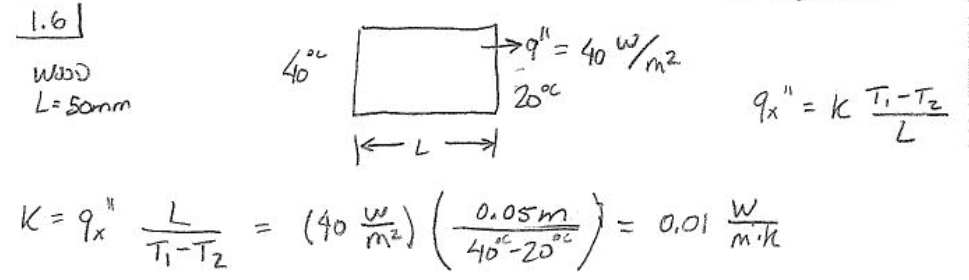
Answer. k = 0.1 W/m·K.
Heat loss through single-pane and double-pane windows
Problem. A 1 m × 2 m glass window, 5 mm thick (k = 1.4 W/m·K), has inner and outer surfaces at 15 °C and −20 °C. Find the heat loss. Then find the heat loss through a double-pane unit with a 10 mm air gap (k = 0.024 W/m·K) whose glass surfaces facing the gap are at 10 °C and −15 °C. (Based on Problem 1.9.)

Answer. About 19.6 kW through the single pane and about 120 W through the air gap, which shows why double glazing cuts heat loss so strongly.
Wall thickness needed for a target heat rate
Problem. What thickness of masonry wall (k = 0.75 W/m·K) carries 80% of the heat rate of a 100 mm structural wall with k = 0.25 W/m·K, if both see the same surface temperature difference? (Based on Problem 1.13.)

Answer. L = 0.375 m.
Pan bottom temperature: aluminum versus copper
Problem. The 5 mm thick bottom of a 200 mm diameter pan is aluminum (k = 240 W/m·K) or copper (k = 390 W/m·K). The water-side surface is at 110 °C and the stove delivers 600 W. What is the stove-side surface temperature for each material? (Based on Problem 1.15.)

Answer. About 110.4 °C for aluminum and 110.2 °C for copper.
Convection heat flux on a hand in air and in water
Problem. A hand surface at 30 °C is held out of a vehicle moving at 35 km/h in −5 °C air (h = 40 W/m²·K), or in a 0.2 m/s water stream at 10 °C (h = 900 W/m²·K). Find the convection heat flux in each case, say which feels colder, and compare with the roughly 30 W/m² lost in a room. (Based on Problem 1.18.)

Answer. 1,400 W/m² in air and 18,000 W/m² in water. Water feels far colder because its heat transfer coefficient is more than 20 times larger.
Comparing heat transfer coefficients for water and air in cross-flow
Problem. A 30 mm diameter cylinder is held at 90 °C by an embedded electric heater. In 25 °C water flowing across it at 1 m/s the heater needs 28 kW/m. In 25 °C air at 10 m/s it needs 400 W/m. Calculate and compare the heat transfer coefficients. (Based on Problem 1.21.)
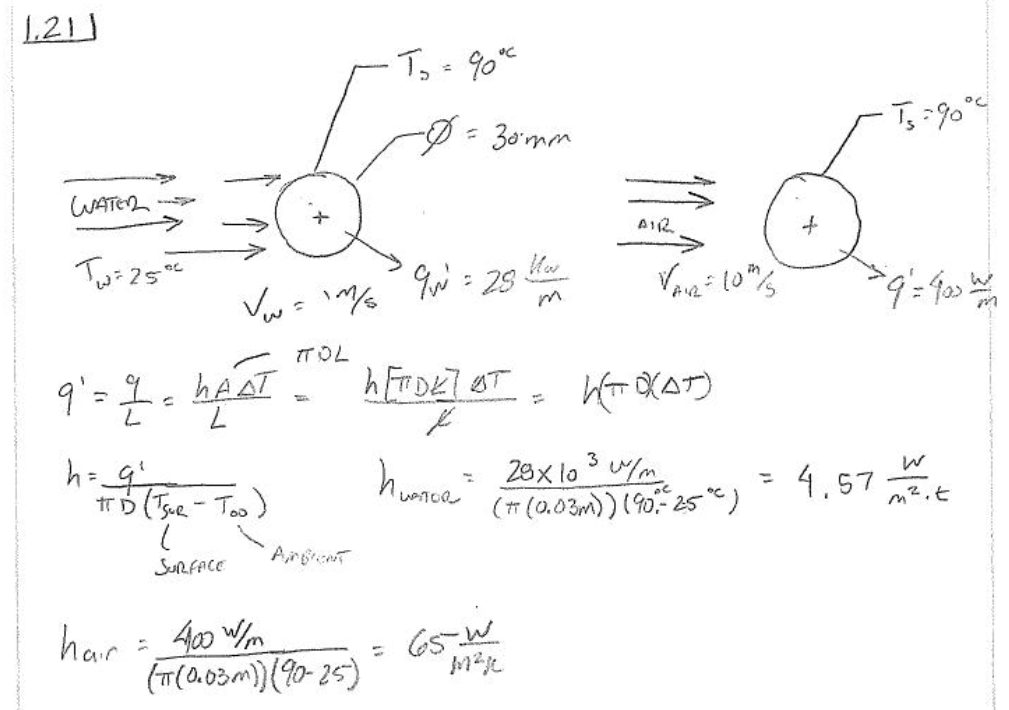
Answer. h ≈ 4,570 W/m²·K for water and ≈ 65 W/m²·K for air, about 70 times higher for water.
Free convection coefficient from the cooling rate of a hot plate
Problem. A thin vertical plate, 0.3 m × 0.3 m, 3.75 kg, c = 2770 J/kg·K, is cooling in still 25 °C air. At 225 °C its temperature is falling at 0.022 K/s. Radiation is negligible. Find the free convection coefficient. (Based on Problem 1.22.)
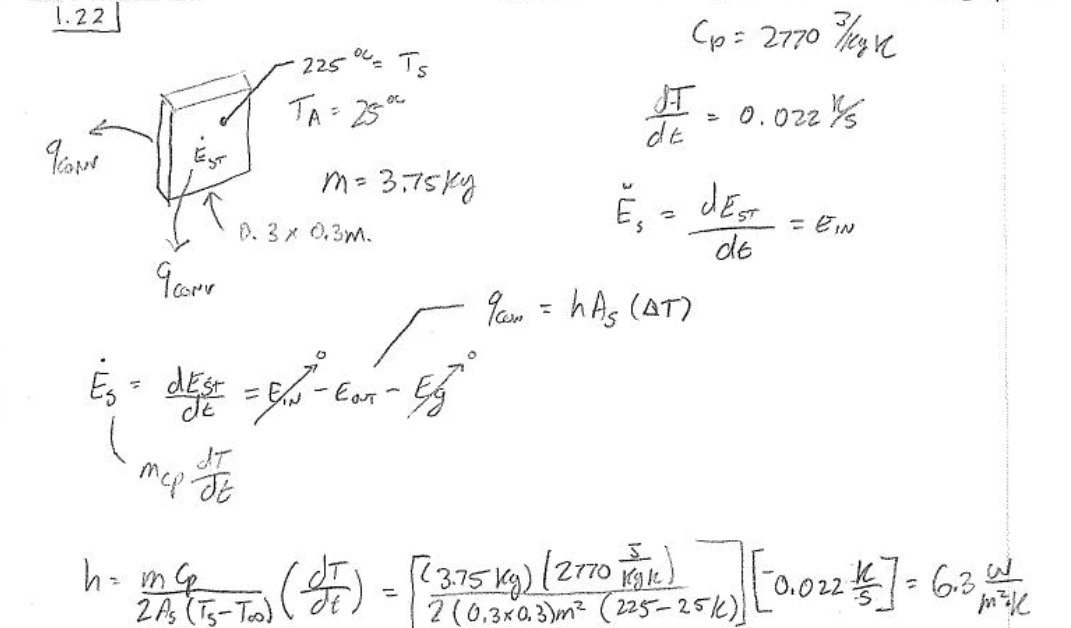
Answer. h ≈ 6.3 W/m²·K, using both faces of the plate.
Emissivity of the same plate in a vacuum
Problem. The plate from the previous problem now cools in a vacuum with surroundings at 25 °C and the same 0.022 K/s cooling rate at 225 °C. What is its emissivity, and at what rate does it emit radiation? (Based on Problem 1.32.)
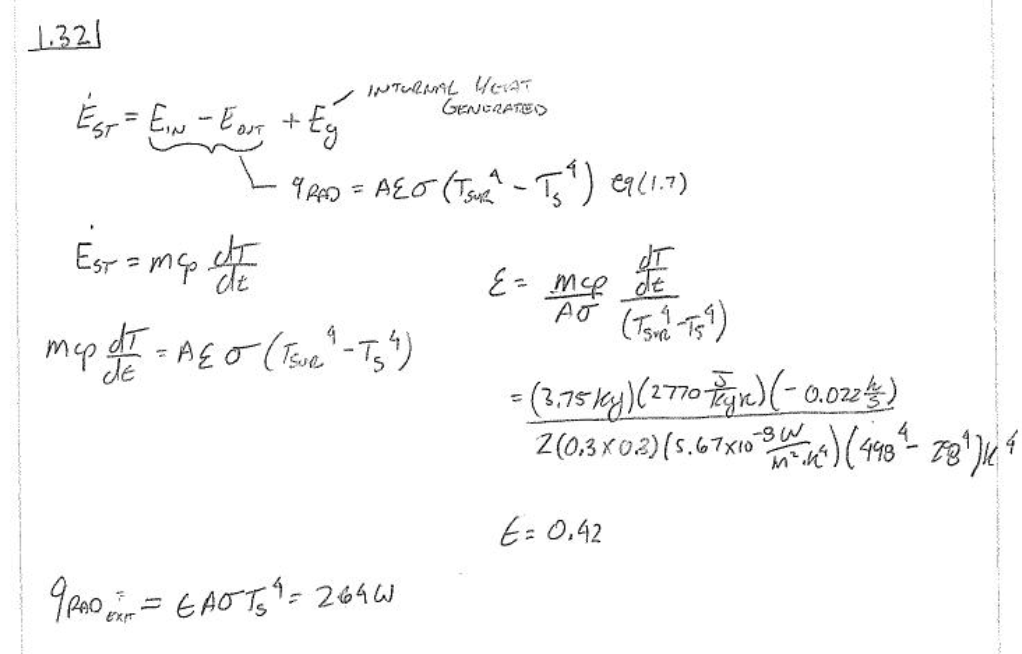
Answer. ε ≈ 0.42 and a net radiation rate of about 229 W.
Transmission case surface temperature
Problem. A transmission case, 0.30 m on a side, receives 150 hp from the engine at 93% efficiency. Air at 30 °C flows over it with h = 200 W/m²·K. What is the case surface temperature? (Based on Problem 1.23.)
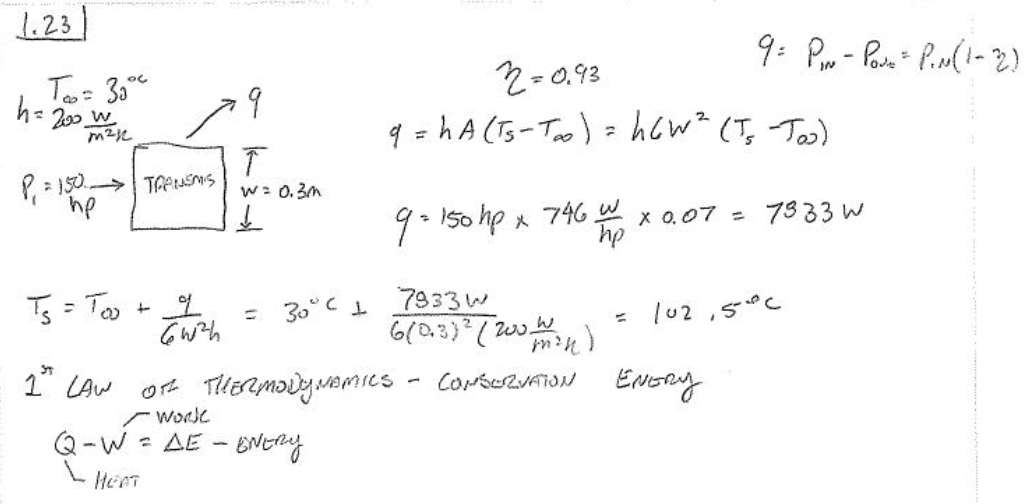
Answer. Ts ≈ 117 °C.
Maximum coolant temperature for a square chip
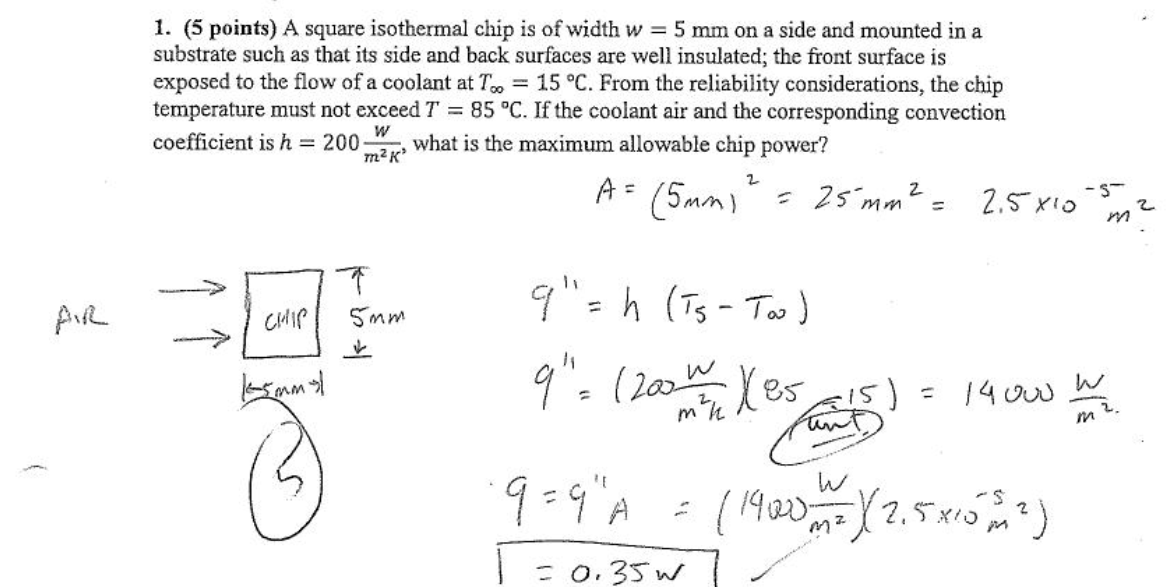
Problem. A 5 mm square isothermal chip has insulated sides and back, and its front face is cooled by a coolant at 15 °C. The chip must not exceed 85 °C. Find the maximum power the chip can dissipate for the coolant conditions in the figure. (Based on Problem 1.26.)
Surface temperature of an interplanetary probe
Problem. A 0.5 m diameter spherical probe dissipates 150 W internally. Its surface emissivity is 0.8 and it receives no radiation from the sun or other bodies. What is its surface temperature? (Based on Problem 1.30.)

Answer. Ts ≈ 254.7 K (about −18 °C).
Chip power limit with natural or forced convection plus radiation
Problem. A 15 mm square chip (ε = 0.60) sits in an enclosure whose air and walls are at 25 °C and must stay below 85 °C. (a) With natural convection, h = 4.2(Ts − T∞)1/4 W/m²·K, what is the maximum chip power? (b) With a fan giving h = 250 W/m²·K, what is it? (Based on Problem 1.40.)
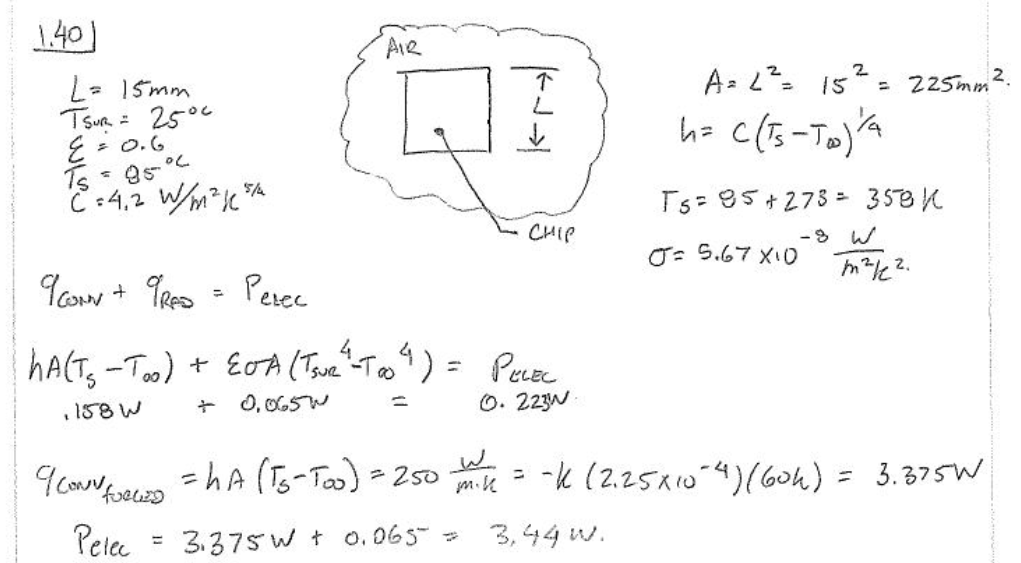
Answer. About 0.22 W with natural convection and radiation, and about 3.4 W with the fan.
Energy generation and wall temperature of a radioactive waste container
Problem. Radioactive waste in a long thin-walled cylinder of radius ro generates heat at q̇ = q̇o[1 − (r/ro)²]. The container sits in a liquid at T∞ with coefficient h. Find the total generation rate per unit length and the container wall temperature. (Based on Problem 1.44.)
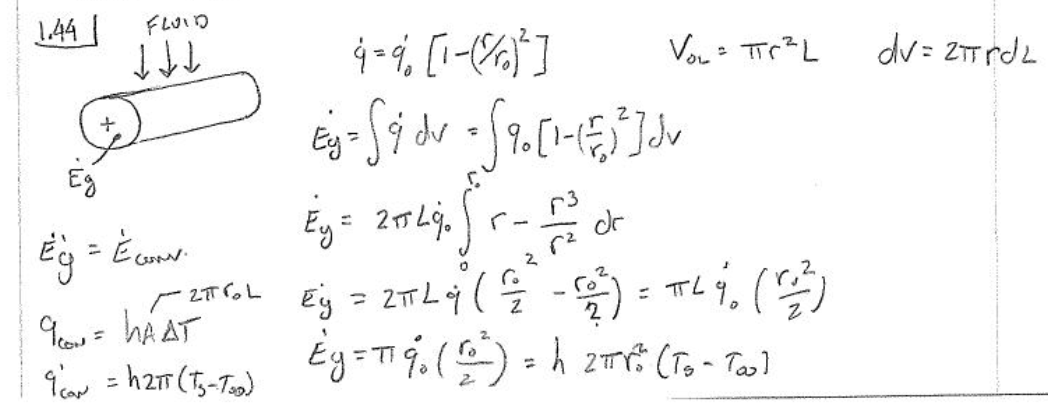
Answer. E′g = π ro² q̇o/2 and Ts = T∞ + q̇o ro/(4h).
Blood warmer heating rate and energy changes
Problem. A blood warmer heats blood from 10 °C to 37 °C at 200 mL/min through a 2 m long tube with a 6.4 mm × 1.6 mm cross-section. What heating rate is needed, and how large are the kinetic and potential energy changes if the fluid flows vertically down the 2 m length (properties of water)? (Based on Problem 1.46.)

Answer. About 376 W of heating. Kinetic energy change is about 2×10⁻⁴ W and potential energy change about 0.065 W, so both are negligible.
Wafer heating rate in a semiconductor furnace
Problem. A 0.78 mm silicon wafer (ε = 0.65, ρ = 2700 kg/m³, c = 875 J/kg·K) at 300 K sits between a 1500 K hot zone and a 330 K cool zone. Gas at 700 K gives h = 8 W/m²·K on the top face and 4 W/m²·K on the bottom. Find dT/dt. (Based on Problem 1.57.)
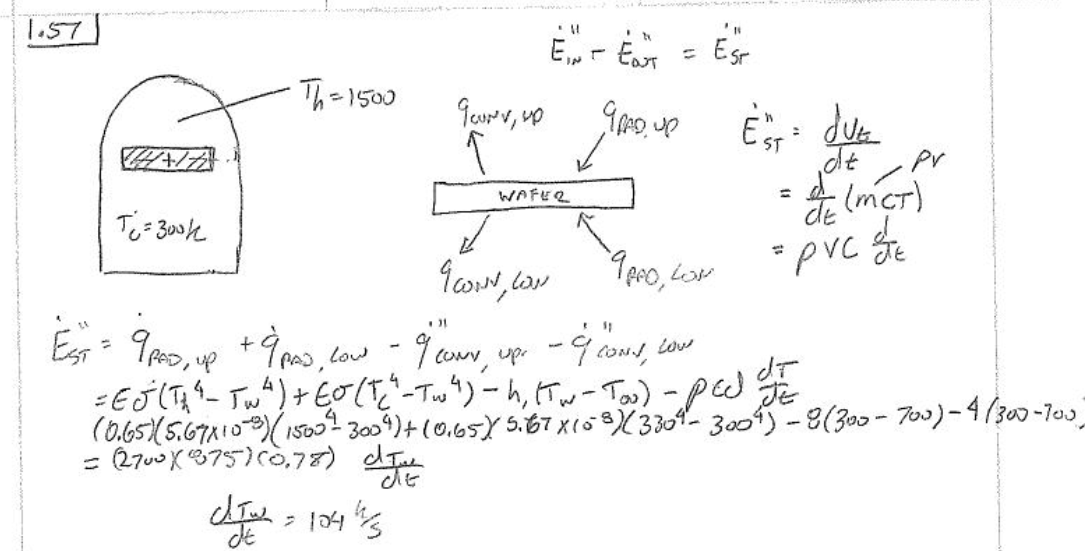
Answer. dT/dt ≈ 104 K/s.
Thermal conductivity from a given heat rate and temperature profile
Problem. Steady one-dimensional conduction occurs in a shape with area A(x) = 1 − x (m²), temperature T(x) = 300(1 − 2x − x³) K and heat rate q = 6000 W, with no internal generation. Derive k(x). (Based on Problem 2.5.)
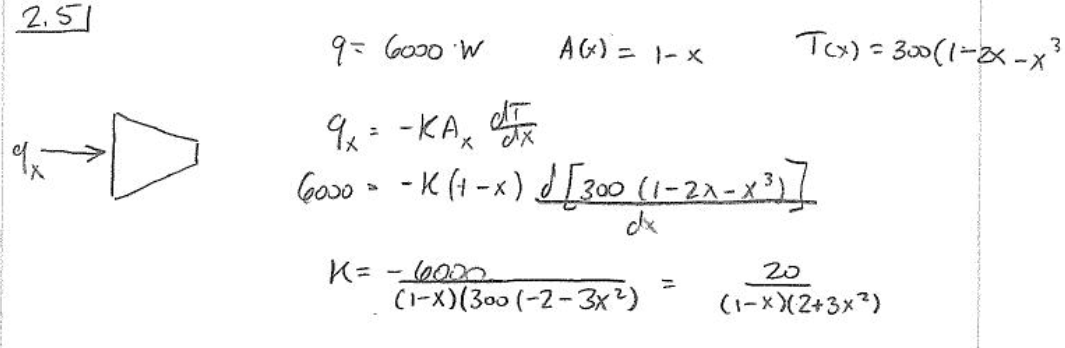
Answer. k(x) = 20 / [(1 − x)(2 + 3x²)] W/m·K.
Temperature distribution with temperature-dependent conductivity
Problem. Thermal conductivity varies as k = ko + aT. Sketch the steady temperature distribution in a plane wall for a > 0, a = 0 and a < 0. (Based on Problem 2.8.)

Wall with internal generation: conductivity and convection coefficient
Problem. A plane wall of thickness 2L = 100 mm generates heat at 1000 W/m³ and is cooled by fluid at 20 °C on both faces. Its steady profile is T(x) = a(L² − x²) + b with a = 10 °C/m² and b = 30 °C. Find k and h. (Based on Problem 2.10.)

Answer. k = 50 W/m·K and h = 5 W/m²·K.
Gradient at a surface with variable conductivity
Problem. For the two-surface geometry shown, k = ko + aT with ko = 10 W/m·K and a = −10−3 W/m·K². The gradient at surface B is ∂T/∂x = 30 K/m. Find ∂T/∂y at surface A. (Based on Problem 2.15.)

Nuclear fuel rod: heat rate and initial heating rate
Problem. A 50 mm diameter fuel rod generates 5×10⁷ W/m³ with T(r) = a + br², a = 800 °C, b = −4.167×10⁵ °C/m², k = 30 W/m·K, ρ = 1100 kg/m³, cp = 800 J/kg·K. (a) Find the heat rate per unit length at the centerline and at the surface. (b) If generation suddenly rises to 108 W/m³, what is the initial dT/dt at both locations? (Based on Problem 2.28.)

Answer. (a) 0 at the centerline and about 98.2 kW/m at the surface. (b) About 56.8 K/s at both locations.
Heat flows and stored energy in a wall with a quadratic temperature profile
Problem. A 0.3 m wall (k = 1 W/m·K) has T(x) = a + bx + cx² with a = 200 °C, b = −200 °C/m and c = 30 °C/m². Per unit area, find the heat rate into and out of the wall and the rate of energy storage. If the cold face sees fluid at 100 °C, what is h? (Based on Problem 2.31.)

Answer. 200 W/m² in, 182 W/m² out, 18 W/m² stored, and h ≈ 4.3 W/m²·K.
Average to local heat transfer coefficient on a rough plate
Problem. Heat transfer over an extremely rough flat plate follows Nux = 0.04 Rex0.9 Pr1/3. Obtain the ratio of the average coefficient to the local coefficient at x.

Answer. h̄x/hx = 1/0.9 ≈ 1.11.
Maximum power per chip with and without a turbulence promoter
Problem. Ten silicon chips, each 10 mm long, are insulated on one side and cooled on the other by 24 °C air at 40 m/s in parallel flow. Power dissipation is the same in each chip, giving a uniform heat flux. No chip may exceed 80 °C. What is the maximum power per chip, and what is it if a turbulence promoter trips the boundary layer at the leading edge?

Heat transfer FAQ
What are the three modes of heat transfer?
Conduction is heat flow through a solid or stationary fluid driven by a temperature gradient. Convection is heat transfer between a surface and a moving fluid. Radiation is energy emitted as electromagnetic waves, and it needs no medium.
What is Fourier’s law of heat conduction?
Fourier’s law states that the heat flux is proportional to the temperature gradient: q″ = −k dT/dx. For a plane wall at steady state it becomes q″ = k(T₁ − T₂)/L.
How do you find the heat transfer coefficient h?
Use a Nusselt number correlation for the geometry and flow, h = Nu·k/L, after checking the Reynolds number. For a lumped object you can also back it out of a measured cooling rate with an energy balance.
Why must radiation problems use kelvin?
The radiation equation depends on the fourth power of absolute temperature, so using °C gives a wrong answer. Convert with T(K) = T(°C) + 273.15 before using εσT⁴.
When can I use the lumped capacitance method?
When the Biot number Bi = hLc/k is below about 0.1, the temperature inside the body is nearly uniform and the object can be treated as one lump.
What is the critical radius of insulation?
For a cylinder, rcr = k/h. If the bare radius is below this value, adding insulation raises the heat loss until the outer radius passes rcr.
Keep learning
- Heat transfer basics
- Radial heat conduction lab experiment
- Forced convection heat transfer and the stirring-rate experiment
- Design of a heat sink
- Battery thermal management 101
- Thermodynamics, entropy and the second law
Discover more from Engineering Cheat Sheet
Subscribe to get the latest posts sent to your email.


