
Supernode and Supermesh
Today, we’re diving into the fascinating world of circuit analysis. I know it might sound intimidating but fear not! We’re going to unlock the power of two incredible techniques: supernode and supermesh. These tricks will help you simplify those complex circuits and make your analysis journey much easier.
Before we jump into supernodes and supermeshes, let’s quickly understand why circuit analysis is such a big deal. In the field of electrical engineering, analyzing circuits is like peering into the soul of any electronic device. It helps us understand how currents flow, voltages interact, and ultimately, how the entire system behaves. Analyzing circuits can be a real headache, especially when dealing with complex circuits. That’s where supernodes and supermeshes come to the rescue! Whether you’ve seen these written as supernode and supermesh, supermesh and supernode, or spaced out as super node and super mesh, they’re the same two shortcuts — sometimes called the supernode concept and supermesh circuits — that we’ll cover below.
Understanding Circuits and Node Analysis
First things first, let’s get familiar with circuits. A circuit is a path that allows electricity to flow, and it consists of various components like resistors, capacitors, and power sources. There are two types of electrical circuits, a series circuit, and a parallel circuit. In circuit analysis, we often deal with nodes, which are points where multiple components connect. Traditional Kirchhoff’s Current Law (KCL) node analysis can get quite messy, as we end up dealing with tons of equations and variables — which is exactly the situation where nodal analysis with supernode techniques (and, for meshes, supermesh circuits) start to pay off.
How do you define a supernode?
In the realm of circuit theory, a supernode is an abstract concept used to solve a circuit. A supernode is formed when we combine two or more nodes to simplify the analysis. By treating a group of nodes as a single entity, we can reduce the number of equations and variables we need to deal with. So what is supernode analysis, in one line? It’s the super node concept applied to nodal analysis — instead of solving for every node one at a time, you fold the ones tied together by a voltage source into a single super node and write one equation for the whole group.

Imagine you have a circuit with multiple nodes, and you want to analyze the currents and voltages. Instead of analyzing each node individually, you can identify a group of nodes that share a voltage source or have the same voltage across them. This group becomes your supernode.
The beauty of a supernode is that you can apply Kirchhoff’s current & voltage law to it just like you would with an individual node. By doing so, you can write a single equation that incorporates the currents and voltages of the components within the supernode. This simplifies the overall analysis and makes it much more manageable.
Can a supernode contain 3 nodes?
A supernode emerges when a voltage source (dependent or independent) is enclosed between two non-reference nodes, along with any components connected in parallel with it. In this scenario, nodes 2 and 3 form a supernode. Yes — a supernode can span more than two nodes whenever several voltage sources chain non-reference nodes together; you simply keep folding each newly connected node into the same supernode. A special case is the quasi-supernode, sometimes called an extraordinary node: it forms when one of the two nodes joined by a voltage source is the reference node itself, so that node’s voltage is already known to be 0V and the supernode equation simplifies further. And because the rule covers dependent voltage sources too, a supernode built around a dependent source works the same way — you’ll just need one extra equation expressing that source’s value in terms of the circuit’s own node voltages before you solve.
Sample problem
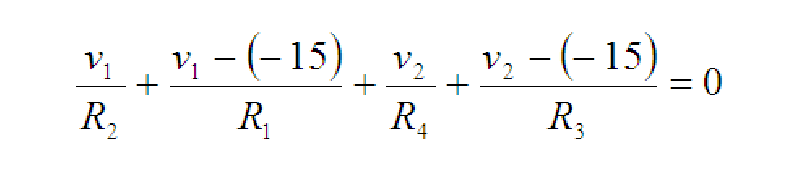
To make things clearer, let’s consider an example. Imagine a circuit with multiple nodes connected to resistors and voltage sources. Instead of dealing with each node separately, we can identify a supernode that includes a voltage source and a few connected nodes. By applying Kirchhoff’s laws to this supernode, we can write a single equation that describes the current flowing through the resistors and the voltage across the voltage source. This allows us to solve for the desired parameters without the hassle of analyzing each node individually.

Solutions:

Worked Numeric Example: Solving a Supernode
Here’s a complete numeric example you can follow with just a pencil and paper. Take a circuit with three non-reference nodes (v1, v2, v3) and a reference (ground) node. A 4A independent current source injects current into node 1. A 2Ω resistor connects node 1 to node 2, a 4Ω resistor connects node 2 to ground, a 5Ω resistor connects node 1 to node 3, and a 1Ω resistor connects node 3 to ground. A 10V voltage source sits directly between node 2 and node 3 (positive terminal at node 2), so nodes 2 and 3 form the supernode.
First, write the voltage constraint for the supernode: v2 − v3 = 10V. Next, apply KCL at node 1 (currents leaving node 1 equal the 4A entering it): (v1 − v2)/2 + (v1 − v3)/5 = 4. Then apply KCL to the supernode itself, summing every current leaving nodes 2 and 3 through the resistors that connect them to the rest of the circuit: (v2 − v1)/2 + v2/4 + (v3 − v1)/5 + v3 = 0. Solving these three equations together gives v1 ≈ 14.06V, v2 = 11.2V, and v3 = 1.2V — and you can check the answer by confirming v2 − v3 comes out to 10V and the current leaving node 1 comes out to 4A.
What is the difference between a node and a supernode?
Nodal analysis offers a method for examining electrical circuits by evaluating the voltage at individual nodes relative to a common reference node, typically the ground. Supernode analysis is a specialized technique where two or more nodes are merged into a single node, particularly for nodes that are separated by independent or dependent voltage sources.
What is the use of Supermesh?
Just like a supernode combines multiple nodes, a supermesh combines multiple mesh currents in a circuit. A mesh is a closed loop formed by interconnected components, and we typically analyze them separately. But when we have current sources within two meshes, it can complicate the analysis. That’s where the supermesh comes in!
To form a supermesh, we include the current source within the loop and treat it as part of the mesh. By doing so, we create a simplified analysis by incorporating the current source’s effect directly into the mesh equation. This allows us to solve for the mesh currents without additional equations or variables.

To solve the example above, combine meshes 1 and 2 into a supermesh. in other words, write a KVL equation around the periphery of meshes 1 and 2 combined. A common mistake made by beginning students is to assume that the voltage across the current source is zero.

Sample problem
Let’s illustrate this with an example. Imagine a circuit with multiple meshes, each containing resistors and a current source. Instead of analyzing each mesh individually, we can form a supermesh that includes the current source within the loop. By applying Kirchhoff’s voltage law to this supermesh, we can write a single equation that accounts for the voltage source’s effect and the resistors’ currents. This simplifies the analysis and makes it much more efficient.

Solution

Worked Numeric Example: Solving a Supermesh
Here’s a fully worked supermesh circuits example. Two adjacent meshes (currents i1 and i2, both assumed clockwise) share a branch containing a 3A current source, oriented so that i1 − i2 = 3A. Mesh 1 also contains a 16V voltage source and its own 2Ω resistor. Mesh 2 also contains its own 4Ω and 2Ω resistors in series (6Ω total).
Since the shared branch carries an unknown voltage, you skip writing KVL for it individually and instead write one KVL equation around the outer boundary of the combined supermesh: 2·i1 + 6·i2 = 16. Combine that with the current source’s constraint, i1 − i2 = 3A, and solve the two equations together: i2 = 1.5A and i1 = 3.5A. You can check the answer by confirming 2(3.5) + 6(1.5) comes out to 16 and i1 − i2 comes out to 3A.
Step-by-Step Guide: Supercharging your Circuit Analysis with Supernode and Supermesh
Now that we understand the power of supernode and supermesh, let’s go through a step-by-step guide to apply these techniques in our circuit analysis:
- Redraw the circuit and count the total number of nodes.
- Choose one node as the reference (ground) node — usually the node with the most connections.
- Label the remaining nodes with unknown voltages v1, v2, v3, and so on.
- Identify every voltage source sitting directly between two non-reference nodes — each one defines a supernode. Enclose it, and anything in parallel with it, in a dotted line.
- Write the voltage constraint equation for each supernode (for example, v2 − v3 = the source’s voltage).
- Apply KCL to every remaining individual node and to each supernode as if it were a single node, summing the currents leaving through every external branch.
- If a current source sits on a branch shared by two meshes, form a supermesh the same way: combine the two meshes and skip writing a separate equation for the shared branch’s unknown voltage.
- Apply KVL around the supermesh’s outer boundary, then add the current constraint equation for the shared source (for example, i1 − i2 = the source’s current).
- Express any dependent-source values in terms of the node voltages or mesh currents you’ve already defined.
- Apply the concept of supernode and supermesh to simplify the equations: Identify groups of nodes that can form a supernode, considering voltage sources and shared voltages. Combine the nodes within a supernode and write a single equation that describes the currents and voltages involved. Similarly, identify meshes that can form a supermesh, incorporating current sources within the loop and simplifying the analysis.
- Solve the resulting system of equations — by substitution, matrix methods, or software — to obtain the node voltages or mesh currents you need.
What is the difference between Supernode and Supermesh analysis?
the difference between supernode and supermesh is that supernodes are employed for nodal analysis in circuits that include voltage sources. Supermeshes, on the other hand, are utilized for mesh analysis in circuits containing current sources. To create a supermesh, identify pairs of meshes that share a branch containing a current source, and combine them into a single loop for analysis.
| Basis | Supernode | Supermesh |
|---|---|---|
| What it combines | Two or more non-reference nodes | Two or more meshes |
| Triggered by | A voltage source between two non-reference nodes | A current source shared by two meshes |
| Governing law | Kirchhoff’s Current Law (KCL) | Kirchhoff’s Voltage Law (KVL) |
| Used with | Nodal (node-voltage) analysis | Mesh (loop-current) analysis |
| Extra equation needed | Voltage constraint across the source (e.g., v2 − v3 = Vs) | Current constraint across the source (e.g., i1 − i2 = Is) |
| Works with dependent sources? | Yes — add an equation for the source in terms of node voltages | Yes — add an equation for the source in terms of mesh currents |
Conclusion
By leveraging the power of supernode and supermesh, you can supercharge your circuit analysis and make those complex circuits a whole lot simpler. These techniques allow you to reduce the number of equations, variables, and headaches involved in analyzing circuits, making the process more efficient and manageable.
So next time you find yourself facing a daunting circuit analysis task, remember to look for opportunities to apply supernodes and supermeshes. Identify those groups of interconnected nodes or meshes that can be treated as single entities, simplifying the analysis and saving you valuable time and effort.
Supernode and supermesh pair well with other circuit-simplification tools, too. Once you’ve reduced a circuit’s nodes or meshes, techniques like Thevenin’s theorem, the Norton equivalent circuit, and voltage and current division can simplify it even further. For a deeper dive into the underlying node concept, see Wikipedia’s overview of the supernode in circuit theory.
Frequently Asked Questions
What is a supernode?
A supernode is an abstract node formed by combining two non-reference nodes that are connected directly by a voltage source (dependent or independent). Instead of solving for each node separately, you treat the pair as one node and write a single KCL equation for the group, plus a voltage constraint equation for the source between them.
What is a supermesh?
A supermesh is formed when two adjacent meshes share a branch containing a current source. Because the current through that shared branch is already known but the voltage across it is not, you combine the two meshes into one loop, skip writing KVL for the shared branch, and add a current constraint equation instead.
What is the difference between supernode and supermesh?
Supernodes are used in nodal (node-voltage) analysis and are triggered by a voltage source between two non-reference nodes. Supermeshes are used in mesh (loop-current) analysis and are triggered by a current source shared between two meshes. Supernodes rely on KCL plus a voltage constraint; supermeshes rely on KVL plus a current constraint.
What is a quasi-supernode (extraordinary node)?
A quasi-supernode, also called an extraordinary node, is the special case where one of the two nodes joined by a voltage source is the reference (ground) node itself. Since the reference node’s voltage is already known to be 0V, the supernode equation for that pair simplifies further than a standard supernode between two unknown nodes.
Can a supernode form with a dependent voltage source?
Yes. A supernode forms the same way whether the voltage source between the two nodes is independent or dependent. The only difference is that with a dependent source, you need one additional equation expressing that source’s value in terms of the circuit’s own node voltages before you can solve the system.
Why do you need a supermesh instead of standard mesh analysis?
Standard mesh analysis assumes you can write a KVL equation for every mesh using only resistor voltage drops. A current source doesn’t have a known voltage across it, so if a current source sits on a branch shared by two meshes, you can’t write a normal KVL equation for either mesh alone. Combining the two meshes into a supermesh sidesteps the unknown voltage and lets you solve with one KVL equation plus the current source’s known value.
Discover more from Engineering Cheat Sheet
Subscribe to get the latest posts sent to your email.


